Last updated on Tuesday, 18, August, 2026
Table of Contents
Teledermatology: How Online Skin Care Works, Benefits, Limitations, and Uses
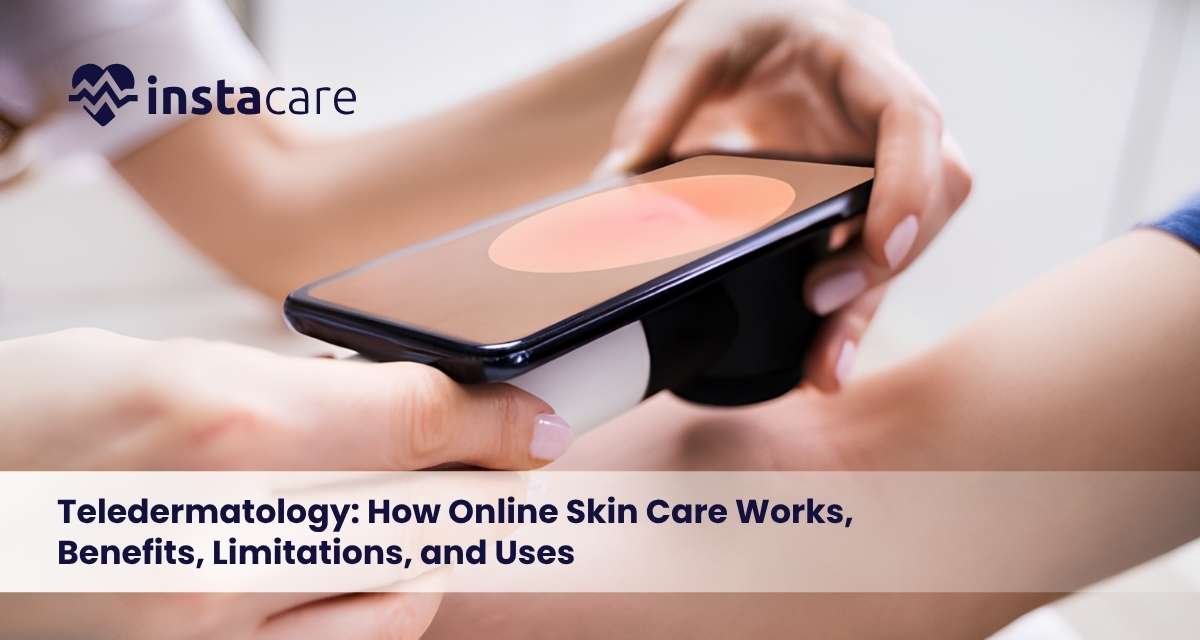
Digital healthcare enables patients to get medical advice and guidance for many health concerns without the need to go to a healthcare facility. One of these is teledermatology. This is the use of photographs and video conferencing coupled with secure messages to assess, diagnose and treat dermatological conditions.
Compared to other fields in medicine, dermatology is more amenable to remote care, because many skin conditions can be observed and diagnosed with a simple video assessment. Teledermatology can be used to improve services to patients, reduce unnecessary travel and allay the need for some patients to see a dermatologist for a follow-up. However, there are many skin conditions which still require an in-person visit for examination and assessment, as well as other procedures for an accurate determination of the condition.
What Is Teledermatology?
Teledermatology is the extension of dermatological care through available telecommunication technologies. Rather than having a face to face meeting with a dermatologist, a patient may submit photographs, provide a description of their symptoms and history to a healthcare professional for assessment.
There are two primary approaches to teledermatology, real-time video consultations and store-and-forward communications. Store-and-forward teledermatology is a telemedicine approach in which the patient photographs their skin condition of concern and submits the photographs, along with relevant medical information, for the healthcare professional to assess at their convenience.
The specific approach in a teledermatology encounter is dependent on the patient’s symptoms, available technologies, and the need for additional diagnostic tests or in-person assessments.
How Does Teledermatology Work?
A typical teledermatology encounter begins with the patient describing their skin concern.
- A teledermatology consultation typically begins with the patient explaining their skin concern.
- When assessing the patient, information may be collected on the following:
- The onset of the skin problem
- Developments or changes in the skin problem (size, shape, color)
- Symptoms relating to the skin problem (pain, itching, burning, sensitivity)
- Current medications
- Previous skin problems
- Allergies
- The patient’s efforts to treat the skin problem
- The patient’s other medical issues
Clear photos can then be submitted through a secure site. In other cases, patients and healthcare professionals have a live video appointment.
Healthcare professionals must rely on what they can see and hear as well as ask many questions about symptoms and medical history during online consultations.
Based on the information, the healthcare professional may suggest a treatment, advise that no treatment is necessary for the time being, request more photos, or advise that the patient be examined in person by a dermatologist.
Types of Teledermatology
Live Video Teledermatology
For live video teledermatology, the patient and the healthcare professional connect using a live video service. The patient is then able to show the healthcare professional the problem area and verbalize their symptoms. The healthcare professional can then ask the patient to change the lighting, move the camera, or show them a closer view of the problem.
This method of communication also allows for a real time client-to-caregiver dialogue, and a client is easily able to ask questions during the consultation.
Store and Forward Teledermatology
Store and forward teledermatology is an electronic capture and submission of photos and medical data for the dermatologist to review at a later time. The dermatologist does not have to be available to the patient at the same time. This may be a more convenient option for people in remote and rural locations where specialist appointments are a long distance away. The quality of the images is very important because poor images can compromise an accurate assessment.
What Dermatological Concerns Can Teledermatology Help With?
Teledermatology can assist with the evaluation and monitoring of various concerning visible skin conditions.
- Acne
- Patients can interact with health care professionals (HCP’s) to discuss breakouts, skin irritations, treatment history and progress.
- HCP’s can monitor advancements in skin condition and treatment response.
- Eczema and Dermatitis
- Certain cases with symptoms presenting as itchiness, dryness, or inflammation, may be assessed through teledermatology.
- The symptoms and any photographs provided can provide sufficient information.
- Psoriasis
- Psoriasis patients can use teledermatology for reviewing the progress of their case, treatment, and medication with health care professionals.
- Rashes
- Sometimes photographs or videos are sufficient to review certain rashes.
- Other rashes can have various causes such as infection, an allergic or a medication-related reaction, or an underlying systemic issue.
- Hair and Scalp Concerns
- Certain scalp conditions, hair loss, dandruff or other scalp inflammations and visible changes can be assessed through teledermatology.
- Nail Concerns
- Evaluation of changes in the texture of the nail can be done through teledermatology.
- Skin Lesions
- Through remote assessment, concerns such as appearance of new moles and spots (“lesions”) can also be reviewed.
- Teledermatology, however, should not replace a physical examination to rule out other serious concerns.
- Remote assessments should not replace an in-person examination when examining patients with skin cancer or other concerning conditions.
- Evaluating various types of skin lesions through remote and in-person examinations has shown that the accuracy of a direct examination is often superior to remote evaluation for some skin lesions.
Book Your Free Marketing Consultation
Benefits of Teledermatology
Teledermatology provides benefits that make this service practical and accessible to individuals that previously did not have access to specialty care.
Easier Access
Teledermatology makes it possible for those living in rural communities without easy access to specialty care to receive an initial assessment without traveling for great distances. Teledermatology can assist healthcare systems to determine which cases warrant an immediate in-person assessment.
Convenience
With virtual consultations, there is less time traveling, less time waiting in clinics, and less disruption to the patient’s normal daily activities. For patients that require many follow-up consultations, managing ongoing care may now be easier.
Faster Initial Assessments
Digital images can be reviewed in a timely manner to assist in determining if a patient can be treated remotely or if an in-person appointment is necessary. In some healthcare systems, teledermatology has been used to assess and provide treatments in a shorter timeframe from the diagnosis to the initiation of treatment.
Helpful for Follow-up Care
For some patients with a known skin diagnosis, a teledermatology consultation and/or photographs may be helpful for an assessment of symptoms, determining if the condition is improving, worsening, or remaining unchanged.
Limitations of Teledermatology
Teledermatology has many advantages, but it is important to acknowledge that it does not eliminate the necessity for some in-person visits.
Image Quality
With an in-person visit, the dermatologist is able to assess the entirety of the patient’s skin; however, if the photographer does not position the camera properly, or if there is poor lighting, blurriness, incorrect angles, or poor image resolution, this may result in the dermatologist missing important details.
No Physical Examination
During an in-person visit, healthcare professionals may closely examine the skin, assess the skin texture, and examine skin that may be difficult to photograph. These assessments may not be possible remotely.
Diagnostic Procedures Cannot Be Conducted Remotely
There are processes that include the following:
- Skin biopsy
- Laboratory testing
- Microscopic examination
- Dermoscopy
- Skin scraping
- Allergy testing
These cannot occur through a regular video or photo consultation.
Some Lesions Require An In-Person Assessment
Suspicious moles, rapidly growing or changing lesions, pigmentation changes, and sores or lesions that may be skin cancer require an in-person assessment. Assessments done in-person and remotely are on a case by case basis.
How to Prepare for a Teledermatology Visit?
Good preparation can help with a remote skin consultation. Patients should take a number of clear, unfiltered, and unedited pictures in a bright, natural light with or without cosmetics. Depending on the state of the skin issue, it may be beneficial to capture images from multiple angles, including close-ups and further away images.
It can be helpful to make notes of how long you have had the symptoms, how long the symptoms have been changing, what treatment you have tried, and any medications you are currently taking. During the video call, ensure a bright light is directed at the affected skin.
When Is an In-Person Dermatology Examination Necessary?
Remote assessment should not replace an in-person assessment. An in-person appointment is necessary if a skin lesion is rapidly growing, changing, or if symptoms are severe or if the diagnosed or undiagnosed condition is not improving with treatment.
Patients should get themselves treated by a doctor as soon as possible if they have symptoms as serious as spreading blisters, swelling, problems breathing, rapid spreading of infection, fever with the rash, and ALL symptoms of medical emergencies.
Is Teledermatology Trustworthy?
The trustworthiness of teledermatology varies, but in situations in which high-quality images and sufficient clinical information are provided, teledermatology is quite effective. Comparison studies show that there is a good level of agreement for both diagnostics and management in a lot of cases.
However, trustworthiness is dependent on the condition being examined, the quality of the images, the history of the patient, and whether a physical exam or diagnostic tests are necessary.
Trusted sources have concluded that teledermatology should not be used to completely replace traditional examinations, but should rather be another method added to the existing services for dermatological care provided.
Conclusion
Teledermatology is a new way to get quick answers for some cosmetic and some medical concerns for the skin, hair, nail and scalp issues by taking pictures and having video consultations and securing digital communication.
It also has the potential to improve the care of dermatological issues, manage existing issues better, and reduce the unnecessary trips that may be caused by insurance and other company restrictions.
Still, there are limits to remote evaluations. A few skin issues will always need a physical exam, and the need for tests, dermoscopy, or a biopsy to provide a diagnosis. The best practice is to combine remote assessments of skin issue and an in-person exam for uncertain or worrisome images.
FAQS
What does teledermatology do?
Teledermatology is useful to help examine the initial symptoms and perform follow-up evaluations of numerous issues of the skin, hair, nails, and scales. A patient can send photos to or do a video visit with a healthcare professional who is then able to determine the severity of the issue and if the patient needs more treatment or a visit in person.
Can a dermatologist make a skin cancer diagnosis from a photo?
A photo can highlight a suspicious lesion and prompt the need for further assessment, but a diagnosis from a photo is not always possible. Some suspicious growths require direct assessment, dermoscopy, or biopsy. There are limits to the assessment of some skin tumors by remote means.
Do you think teledermatology is as valuable as an in-person visit?
For many conditions and follow-up care, teledermatology can be extremely valuable, especially with the use of quality photos and detailed reports from the patient. Some skin conditions still require an in-person visit for a proper and accurate evaluation.