

Last updated on Wednesday, 17, December, 2025
Last Updated on 4 months ago by Ahmed Usman
Table of Contents
AI Medical Scribes: Transforming Clinical Documentation in Modern Healthcare
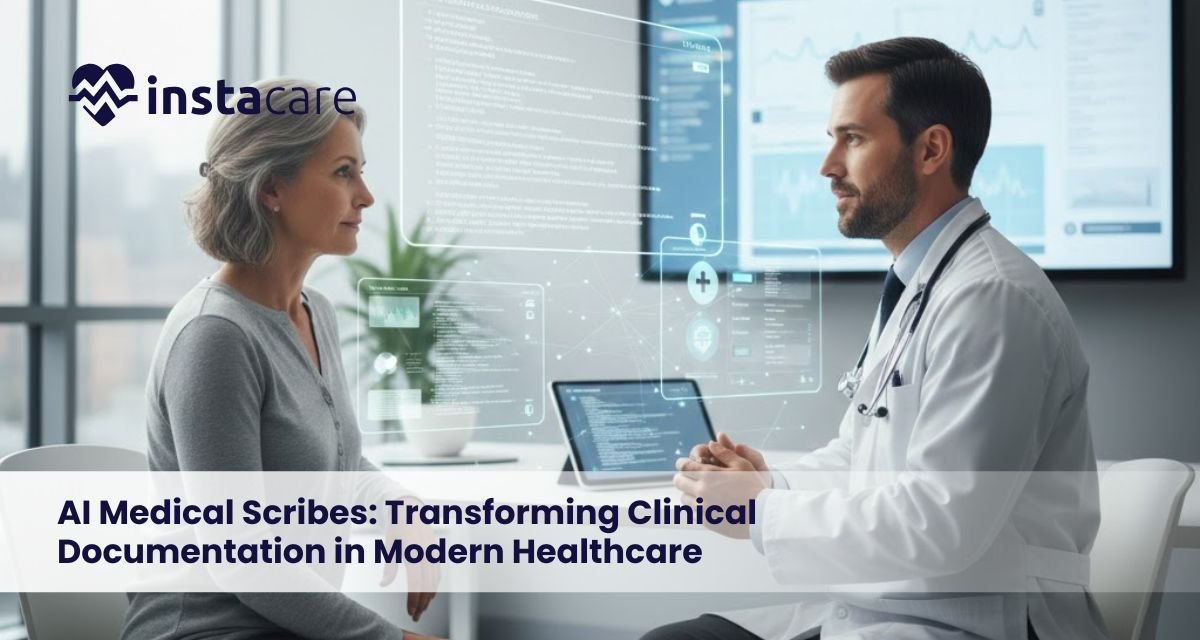
Clinical documentation has been considered one of the most time-consuming components of the healthcare delivery process. Doctors usually take hours to type in documentation in systems rather than attending to patients. AI medical scribes are altering this fact as they automate documentation processes, reduce burnout, and improve efficiency in healthcare environments. Speech recognition, natural language processing, and ambient clinical intelligence together are transforming the way medical records are made and handled.
What Are AI Medical Scribes?
AI medical scribers represent smart software applications to automatically record, transcribe, and organize medical dialogue between providers and patients. As opposed to manual writing of notes, AI scribe software listens to real-time communications and translates them into precise and well-formatted medical notes. Such an implementation of medical AI documentation is fully compatible with the present electronic systems, and clinicians can use it without interfering with patient interaction.
These tools are also known as virtual medical scribes, and they do not require a human scribe, but they still have clinical accuracy and consistency.
Key Features of AI Medical Scribes
The current AI medical scribes are powered with highly qualified features that facilitate effective documentation:
- Real-time speech-to-text conversion in speech recognition in healthcare
- Automated structuring of SOAP notes and clinical summaries
- Easy integration of electronic health record (EHR) documentation
- Medical terminology context-awareness
- Cloud-based access control and storage
- Constant training to get better at transcription
All of these features allow automated clinical documentation without increasing the administrative load of clinicians.
Benefits of AI Medical Scribes
The introduction of AI medical scribes can be of great advantage to medical professionals and organizations:
Time savings: AI medical scribes save a lot of time in documentation, and instead, physicians spend more time interacting with patients, assessing them, and providing personalized care at an appointment without being distracted by the administrative task at hand.
Less burnout: AI documentation tools will enable clinicians to have a more balanced work-life schedule and decrease mental exhaustion and professional burnout due to the reduction of after-hours charting and paperwork.
Better fidelity: AI-powered medical transcription gives the medical institution a more accurate representation of clinical data, minimizing the errors in documentation caused by typing by hand, haste, or incomplete killer.
Improved patient experience: Since less attention is paid to screens, healthcare professionals are able to look straight into the face of their patients, listen and establish better relationships with them during consultations.
Operational efficiency: A quicker process of clinical note development enhances the efficiency of the working process, decreases time spent by patients in line, and allows a healthcare institution to work with a larger number of patients through advanced clinical note automation.
The automation of clinical notes will allow the healthcare team to concentrate on the quality of care instead of paperwork.
Use Cases in Healthcare
Medical scribes AI are common in various clinical settings:
- Routine check-up clinics of patients
- Cardiology, orthopedics and psychiatry Specialty practices
- High activity emergency departments
- Online medicine and virtual visits
- Inpatient rounds and outpatient follow ups
The AI scribe for doctors can fit into the various clinical workflows in a practice hence it is applicable in a small practice as well as a large hospital system.
AI Medical Scribes and Compliance
Healthcare documentation involves a major issue of compliance. Medical scribes are AI that are created to comply with high data protection and privacy standards. The majority of solutions are based on HIPAA, GDPR, and local healthcare regulations by:
- Cryptography of audio and textual data
- Limiting access based on role-based access control
- Keeping of good audit documents
- Assuring safe integration to EHRs
Automated clinical documentation can be most effective and not only in accordance with the regulatory requirements, when done properly.
Challenges and Limitations
Although AI medical scribes have benefits, they also have challenges:
- Preliminary setup and workflow optimization
- Accent variation, speech patterns, or noisy surroundings
- Clinician review is necessary to ensure contextual accuracy
- Reliance on audio input of quality
Nonetheless, the current developments in speech recognition in healthcare keep enhancing the reliability and performance.
AI Medical Scribes vs Traditional Documentation Methods
Conventional records are based on manual typing, dictation, or human scribes. Conversely, AI medical scribes offer:
- Faster turnaround times
- Reduce long-term operation costs
- Regularity of the documentation quality
- Elastic solutions that are staffing-free
The flexibility of human scribers does not match the efficiency and scalability of clinical note automation that AI can bring when compared to manual systems.
Future of AI Medical Scribes
AI medical scribes have a strong connection to ambient clinical intelligence innovations. The next developments would be:
- Involuntary documentation with no hand interventions
- More profound context knowledge of patient history
- Suggestions of predictive documentation
- Improved cross-platform healthcare interoperability
With the development of technology, AI medical documentation will be a part and parcel of digital healthcare transformation.
Conclusion
AI medical scribers are transforming the definition of clinical documentation by lessening the workload of the administrators, refining the level of accuracy, and improving the interactions between the patients and their health providers. Through AI-based medical transcription and intelligent automation, healthcare workers could rediscover lost time and concentrate on delivering quality care. When combined with electronic health records and Lab Management Software, AI medical scribes help create a more connected, accurate, and efficient clinical workflow across departments.
FAQs
Are medical scribers using AI accurately enough to be used in clinical practice?
Yes, the majority of AI medical scribes reach a high level of accuracy and keep learning with time. Clinicians have an opportunity to make corrections to clinical notes and verify their correctness.
Substitute Human scribes with AI medical scribes?
They also substantially decrease the use of human scribes, though quality assurance and compliance still have to be assured by the final review of clinicians.
Do AI medical scribes support current EHR solutions?
The majority of the current solutions facilitate the electronic health record (EHR) documentation and are integrated with significant healthcare platforms.