
Last updated on Thursday, 8, January, 2026
Last Updated on 3 months ago by Ahmed Usman
Table of Contents
Cloud Analytics in Healthcare: Transforming Data into Better Patient Care
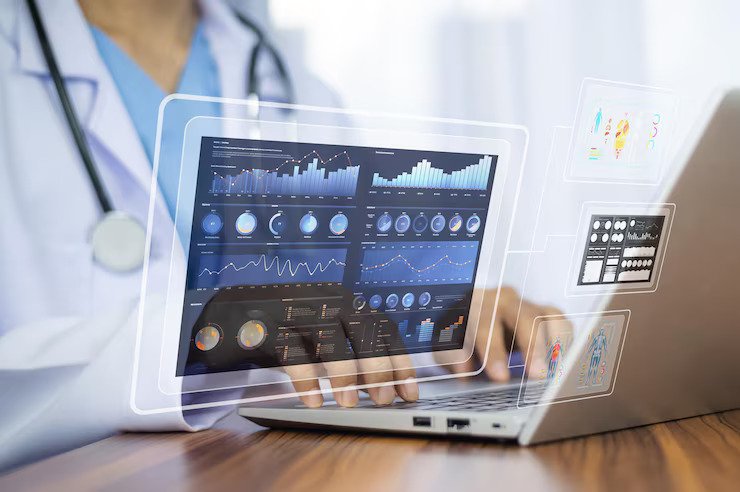
The field of healthcare is becoming more data-driven, whether it is the electronic health records (EHRs) or the medical imaging and patient monitoring gadgets. The problem with traditional methods of analytics is that they do not often run such large and intricate data effectively. The analytics of cloud failure in healthcare offers the ability to convert raw data into actionable insights in a scalable, flexible and safe way. Using Cloud analytics for healthcare operations, organizations have the possibility to improve patient outcomes, streamline operations, and fund research and public health activities.
What Is Cloud Analytics?
Cloud analytics is identified as the trend of conducting data analysis on cloud computing platforms instead of local computers. It enables healthcare organizations to gather, store, and process vast amounts of health-related data with no on-premis infrastructure constraints. To be suitable even in the modern healthcare setting, the cloud is capable of real-time data access, advanced analytics, and data integration based on diverse data sources.
Key aspects:
- Storing of health records and datasets at a central point.
- Big data processing by scaling the computing power.
- State-of-the-art analytics applications that are available on the web.
- Minimized IT infrastructure expenses and support.
Why Healthcare requires Cloud Analytics
Medical care produces massive volumes of data on a daily basis. Clinics, research centers, and hospitals require ways of efficiently handling and analysing such information. Healthcare cloud computing handles the challenges by:
- Giving real-time access to patient information in different facilities.
- Funding predictive analytics to prevent diseases.
- Empowering information-based patient care and operations.
- Offloading the load of internal IT systems.
In the absence of cloud analytics, several of the healthcare institutions are unable to utilize the potential of their data in order to achieve more in terms of patient care and operational efficiency.
Major Elements of Cloud Analytics in Healthcare
Cloud analytics is effective based on a number of elements:
- Data Sources: EHR, IoT medical devices, imaging systems, laboratory data, and PFD.
- Cloud Infrastructure: Provides storage, computing capabilities and analytics services.
- Analytics Tools: Machine learning algorithms, visualization dashboards and predictive models.
- Administrative Control: Encryption, access control, and healthcare compliance.
- Integration Abilities: APIs and interoperability to integrate different hospital systems.
These elements combined make up the basis of cloud analytics systems customized to the health care requirements.
Significant Healthcare Cloud Analytics Advantages
The advantages associated with the use of cloud analytics in healthcare organizations are visible:
- Improved Patient Care: Real- time information enables clinicians to make sound decisions.
- Operational Effectiveness: Healthcare operational analytics simplifies operational processes, human resource management, and resource distribution.
- Population Health Management: The analysis of large-scale data can assist in tracking the tendencies and disease outbreaks.
- Cost Reduction: Combats infrastructure and maintenance expenses and enhances scalability.
- Data-Driven Research: Speeds up clinical research and increases the accuracy of medical research.
Applications of Cloud Analytics in Healthcare
Examples of health care apps that apply the power of cloud analytics include:
- Predictive Analytics: Hospital admission, readmission, and managing chronic diseases.
- Patient Risk Stratification: Asking at-risk patients to be early-interventioned.
- Medical Imaging Analysis: Faster and more accurate medical diagnostics with the help of AI-driven analytics.
- Telehealth Integration: Promoting virtual care and remote monitoring.
These applications are based on real-time healthcare analytics in the cloud, which would allow clinicians to react proactively and not reactively.
Patient Care Improvement and Cloud Analytics
Using cloud analytics, hospitals will be able to:
- Monitor the effectiveness of the treatment of the tracks in the long run.
- Individualize care plans depending on the patient history.
- Identify the early warning of complications through predictive models.
- Enhance medication control and minimize errors.
Such understanding can assist their clinicians to provide more accurate, timely and patient-centered care.
Role in Research and Public Health
Healthcare big data analytics in the cloud enables authorities in the health sector to track disease outbreaks, vaccination levels, and health trends of the population. The researchers have access to big anonymised datasets of epidemiological research, clinical trials, and healthcare innovation. With cloud solutions, it is simpler to combine and interpret multiple sources of data and retain privacy.
Cloud analytics for population health facilitates preventive healthcare, early interventions and effective distribution of resources within communities.
Book Your Free Marketing Consultation
Security, Privacy and Compliance
Patient confidentiality is a matter of concern in healthcare. HIPAA-compliant cloud analytics solutions provide security and encryption of patient data to authorized staff, and only authorized personnel can access it. Cloud systems have stringent regulatory policies, such as audit trails, role-based access, and breach detection systems.
Cloud computing and data protection in healthcare ensure patient trust and compliance with the law. Violation of any of these may have grave implications, both legally and in regard to patient safety.
Issues of Cloud Analytics Implementation
Even with such benefits, healthcare organizations do not pass without challenges:
- Integration with legacy systems.
- Assuring the quality of data.
- Personnel education and implementation of new systems.
- Initial set up and management cost.
- Cyber threats and regulatory requirements.
These challenges need strategic planning, resources and collaboration with seasoned cloud analytics vendors.
Future Prospects of Cloud Analytics in Healthcare
Cloud analytics are going to transform further in the future:
- Personalized care predictive models (AI-powered).
- Increased interoperability between hospitals and labs.
- Use of cloud analytics to make clinical decisions.
- Extended use of edge computing to achieve faster real-time insights.
- Genomics and precision-medicine solutions on clouds.
The combination of cloud computing and healthcare analytics will further enhance patient care and efficiency.
Best Practices in Healthcare Organizations
The healthcare organizations are advised to:
- Select HIPAA-compliant and secure cloud platforms.
- Educate employees on data analytics and interpretation.
- Institute data quality and utilization governance.
- Introduce pilot programs then proceed to full scale implementation.
- Periodically examine the results of analytics in order to enhance patient care.
Through these practices, healthcare institutions are able to exploit cloud data analytics without undermining safety and compliance.
Conclusion
Cloud analytics in healthcare is transforming the way hospitals, clinics and researchers utilise data. Cloud-based healthcare analytics is a groundbreaking instrument in terms of increasing operational efficiency and research outcomes as well as improving the care of patients and the management of populations. Nevertheless, despite existing challenges, best practices, compliance, and careful planning enable healthcare organisations to utilise cloud analytics platforms to the maximum. Healthcare is becoming data-driven, and the future of these changes lies in cloud analytics.
FAQs
What do you mean by healthcare cloud analytics?
Use of Healthcare cloud analytics to gather, process and analyze healthcare data to help in better patient care and operations are considered to be better.
What is the value of cloud analytics in patient care?
Enabling the use of Cloud analytics for clinical decision support will help hospitals to anticipate risks, tailor treatment plans, and identify complications at an early stage.
Are cloud analytics solutions safe with healthcare data?
Indeed, cloud analytics solutions that are HIPAA compliant rely on encryption, access control and monitoring to guarantee cloud analytics and healthcare data security.