Last updated on Friday, 10, July, 2026
Table of Contents
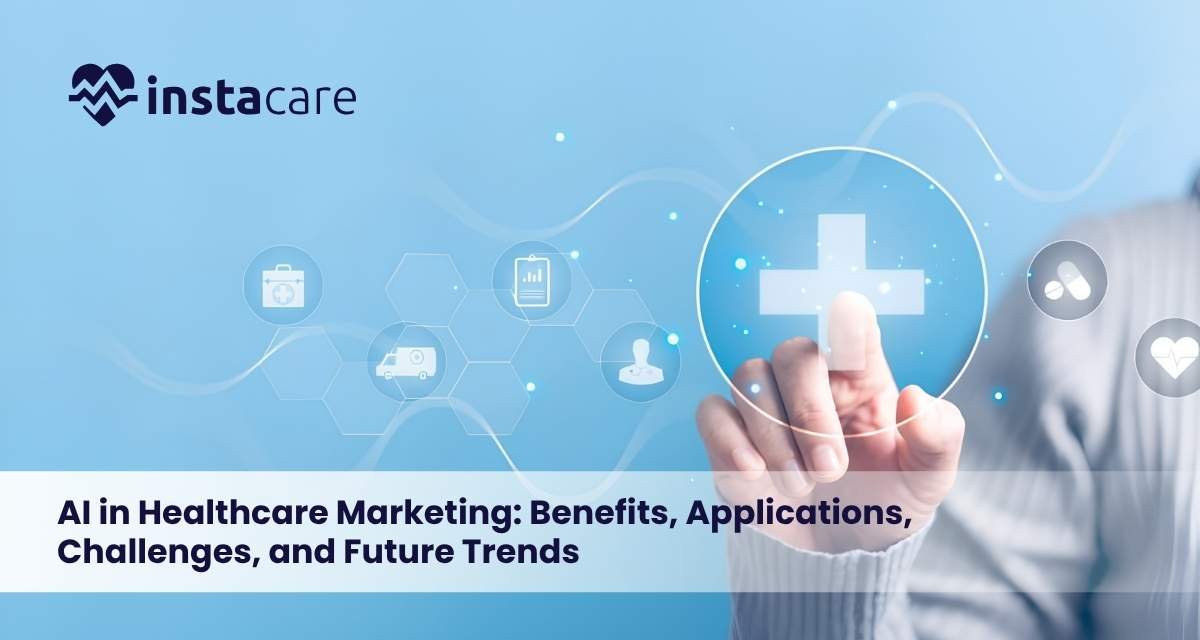
AI in Healthcare Marketing: Benefits, Applications, Challenges, and Future Trends
Communication, digital marketing, audience behavior analysis, and content creation are all being transformed by AI in the healthcare space. Healthcare marketers now have the opportunity to use advanced software to analyze data. This leads to enhanced communications, personalized patient experiences, automation of redundant tasks, and the ability to make more informed marketing decisions.
AI is being adopted in healthcare to an ever-increasing extent. However, the sensitive nature of healthcare data and the introduction of privacy, transparency, accuracy, equity, and trust issues through the use of AI means that its application needs to be justified.
When its application is justified, AI can improve the efficiency of healthcare marketing while doing neither the thinking nor the caring for the profession.
What Is AI in Healthcare Marketing?
AI in healthcare marketing means that technology such as machine learning, natural language processing, predictive analytics, and generative AI can be employed to enhance the marketing and communications functions.
These technologies can assist healthcare marketers to understand their audiences, evaluate the performance of their campaigns, draft content, sort communications, improve web experiences, and optimize communications.
One of the many possible applications of AI in marketing is that an AI system can evaluate how different audience segments engage with a piece of instructional content. Based on the analysis, marketing teams are better informed and can align campaigns to issues that audience segments prioritize.
AI can assist with the many marketing decisions that healthcare marketers must make; however, there needs to be a significant amount of human oversight in the actual communication. As a result, there needs to be a focus on both transparency and communication when AI is being employed in health-related areas.
Why AI’s Role in Healthcare Marketing is Rising?
Compared to other industries, marketing in healthcare has its own nuances. For instance, when someone is looking for health-related information, they may feel anxious, confused, or need answers to difficult questions.
In such circumstances, standard marketing messages are ineffective.
The integration of AI in marketing allows the analysis of tremendous amounts of data and the identification of patterns with unprecedented speed and efficiency. Consequently, organizations stand to gain insight into:
- What information is being sought?
- What topics spark engagement?
- What are the drop-off points on the sites?
- What channels are most effective?
- What are the most common queries?
- What campaigns require adjustment?
How communication and data could be protected while keeping the utmost transparency, ethics, integrity, and oversight
Improving Patient Communication
The most important of the predicted impacts of AI on healthcare marketing is the ability to personalize communications.
Information needs are different for different individuals. For example, information on preventive care is different from that which is needed on rehabilitation and long-term care management.
With AI, organizations will be able to build segments of different groups based on their varied interests, behaviors, preferences, and engagements.
The degree of personalization has the potential to influence:
- Content of emails
- Recommended educational articles
- Reminders for scheduling and keeping appointments
- Suggested content on web pages
- Most common queries
- Follow-up communications
Personalization in this context must be conducted with caution, and health data and personal information must be protected and secured. Privacy regulations also outline concerns regarding online tracking frameworks and health-related data.
AI for Healthcare Content Creation
Online content is critical for marketing in healthcare. People look to the web for information on symptoms, procedures, preventive care, recovery, wellness, and treatment.
AI can help content teams in a number of different ways:
- Create ideas for topics.
- Create outlines.
- Draft headings.
- Draft content.
- Edit for simplicity.
- Draft FAQs.
- Edit for tone and readability.
- Create social media drafts.
AI tools should not be used to generate healthcare content without a thorough review.
Generative AI tools can produce content that is wrong, incomplete, false, or too confident. The guidance for the global health community states that the use of AI tools in health-related contexts requires the governance of the safety and interests of AI users; the use of AI in health-related contexts requires accountability and transparency. Content should always be reviewed for health and medical information.
Chatbots and Automated Patient Support
Digital communications are rapidly adopting AI-based chat tools.
A chatbot can assist visitors to a website in finding information and service pages, learning about hours and appointments, and answering questions about common administrative issues. For marketing and communications teams, chatbots can aid in addressing common questions.
Examples of support that can be appropriately automated include:
- Providing information about services.
- Answering questions about administrative processes.
- Providing information about appointments.
- Answering basic non-diagnostic questions.
- Providing contact information.
A chatbot should not be interpreted as a substitute for professional healthcare assessment. It is critical that the chatbot maintain appropriate boundaries and that there is a proper escalation to human support concerning questions about healthcare.
Predictive Analytics in Healthcare Marketing
Using past and present data to trace patterns and anticipate likely future events is known as predictive analytics.
In the case of healthcare marketing, this data may show teams which of their campaigns might be the most successful, which methods of communication might be most effective, and which different groups in the healthcare system might be most inclined to react to which marketing messages.
Some uses of predictive analytics might be:
- Campaign planning
- Audience segmentation
- Content suggestions
- Communication strategies for appointments
- Budget distribution
- Engagement analysis
Making these predictions will allow healthcare marketers to move beyond the level of guesswork. It is important to note, however, that predictions are not certainties. The output provided by an artificial intelligence system is determined by the data that is utilized to program the system. In the case of the artificial intelligence systems that are used in healthcare, a lot of factors come into play and may require the system to be updated frequently.
AI and Search Engine Optimization
AI may also be used to implement more effective healthcare Search Engine Optimization (SEO). People’s search behavior changes over time, and people often ask more conversational questions when searching for healthcare-related information. AI tools may be able to identify the relationships between topics, frequently asked questions, content gaps, and methods by which improvements may be made.
Healthcare marketers may use AI when:
Grouping keywords
- Creating clusters of related topics
- Analyzing the intent of a search
- Identifying content gaps
- Developing ideas for internal links
- Formulating frequently asked questions (FAQs)
- Planning the content to be updated
Even though AI may be a helpful tool, developing a large quantity of poor quality content to improve the ranking of a website is unlikely to provide long-lasting benefits.
The content generated as a result of Healthcare SEO efforts should be clear, helpful, accurate, and truly relevant. AI may assist the content generation process, but it should not take the place of skilled writers and professional reviews.
Book Your Free Marketing Consultation
Campaign Automation and Optimization
When marketing in the healthcare space, campaigns across multiple search, social media, email, website, and digital marketing channels need to be managed.
AI-driven automation can analyze the performance of a campaign and automate adjustments to certain campaign elements.
Examples include:
- Finding audience segments that perform better
- Analyzing variations of messages
- Targeting the best timing for campaigns
- Recognizing patterns in engagement
- Finding content that performs worse
- Making budget recommendations
AI automation can remove repetitive tasks. However, AI systems will optimize a campaign for clicks or conversions, and will not recognize the sensitivity of a certain health topic, so messaging of a campaign should always be reviewed.
The Respect, Accuracy, and Appropriateness of Marketing
AI in the Healthcare Space Marketing
AI, when used in the healthcare space marketing in a responsible manner, can have multiple benefits.
Improved Efficiency
AI can automate the completion of a number of administrative and repetitive tasks, like data organization, report writing, response sorting, and content ideation.
Better Understanding of Audience Segments
Analysis of digital content engagement can indicate the types of content people need and can enhance the understanding of audience segments.
Relevancy of Communication
Audience interest messaging content can be delivered through segmentation and personalization that is AI-driven.
Improvement in the Speed of Analysis
Healthcare marketing can benefit from the rapid analysis of campaign performance and identification of the need to adjust campaign elements.
Enhanced Digital Interactions
AI can enhance ease of navigation of healthcare websites through chat-based assistance, content recommendations, search, and other ease of use features.
The Challenges Presented by AI
While there are benefits to the responsible application of AI technology, there are significant challenges that also need to be considered.
Protection of Data
Collection, analysis, and storage of sensitive health data need to be carefully considered.
Healthcare Content Publication
Ensuring the accuracy of AI-generated content is vital, particularly when publishing content related to healthcare. Because this type of content often includes a higher risk to the reader, it is imperative to check for errors or misleading information.
AI systems cannot identify how audiences will interpret information or how recommendations will ultimately be perceived in the real world due to the inherent imbalances in the training data.
AI systems cannot identify a reader’s emotional state. And while healthcare communications AI, for example, may be able to suggest content, the completion of that communication will require human involvement to exercise judgment.
People should not be misled about how automated systems are being used. AI in the health domain should communicate with users about the limits of its systems, and where humans must be in control.
AI in Healthcare Marketing
Applications of AI in marketing will be beyond our current understanding. They will be used for personalization and improvement in the speed and quality of communications. AI will also be used to deepen integration across platforms and build better conversational interfaces and handle translation more efficiently.
Healthcare communications and marketing will still require a human presence, especially for trust-building tasks. AI will be an essential business tool, but humans will still be able to evaluate the AI for ethics and accuracy. Marketing communications in healthcare will depend on the best use of both AI and human communications.
Conclusion
Automation and AI do offer a lot of options for personalization, audience analysis, planning content, improving communication with patients, and optimizing campaigns.
Capturing all these options in the context of healthcare marketing, where sensitive content and responsibilities associated with communication exist, will certainly need some level of commitment to privacy, human oversight, and tact.
Those who use AI in a supportive function and not as a complete substitute for professionals, will be communicating more efficiently, more relevantly, and more responsibly post AI. The future will favor the most effective AI supplemented with human professionalism, creativity, and empathy.
FAQS
How Is AI Used in Healthcare Marketing?
Some of the most common applications of AI in healthcare marketing include support automation, AI-enabled personalization, integrated marketing apps, audience segmentation, campaign predictive analytics, performance measurement analytics, and SEO health checks. AI helps marketing and communication teams become more efficient and effective.
Can AI Replace Healthcare Marketing Professionals?
Although AI can help with repetitive tasks and some analyses, AI cannot replace the need for strategizing or creativity, empathy, and ethical decision-making. Careful communication is necessary for marketing in healthcare, so AI cannot oversee this.
Is AI-Generated Healthcare Content Reliable?
Just because AI created the content does not mean it is accurate. Content can still be generated with AI and contain outdated or even incorrect information. Healthcare content that is generated with AI should be edited and checked thoroughly before release, especially if the content discusses symptoms, conditions, medications, procedures, or even treatment.