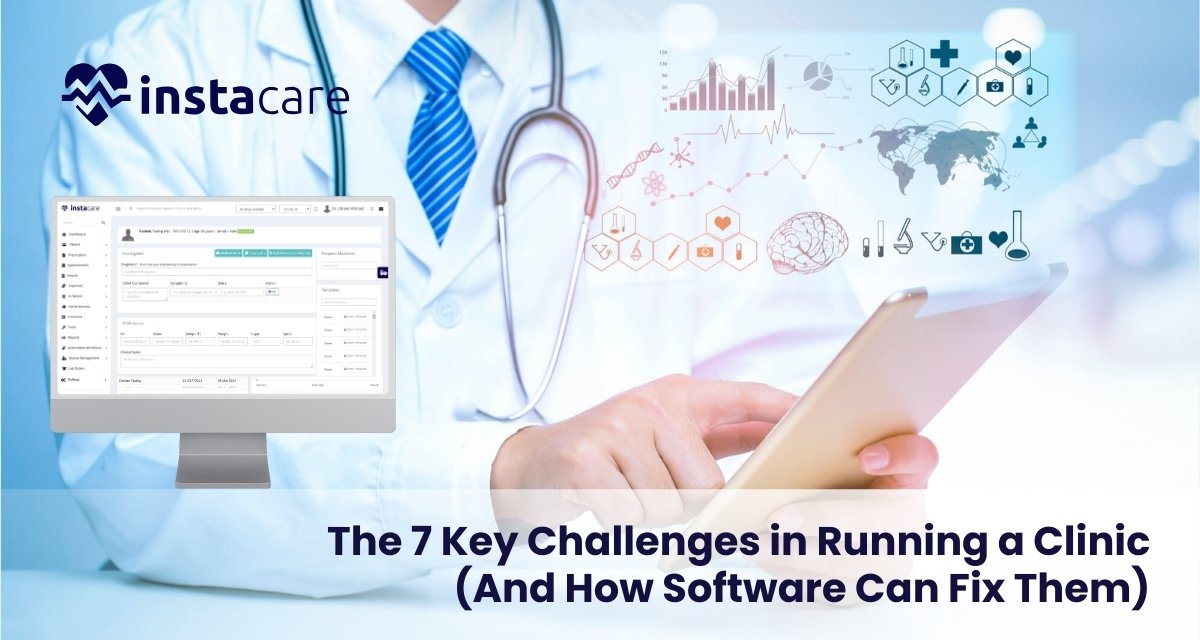
The 7 Key Challenges in Running a Clinic (And How Software Can Fix Them) Running a clinic poses many problems in running a clinic that may have significant effects on patient care and operational efficiency. Issues such as overworked staff, scheduling conflicts, and billing errors are major concerns to clinic owners. However, modern clinic software directly addresses these Challenges in Running a Clinic and in the management of the clinic, thus improving overall productivity and enhancing patient satisfaction. Here are the 7 Key Challenges in Running a Clinic & their Solution 1. Overworked Staff One of the Problems with Clinic Management is that of staff burnout because of overwork. Most of the administrative work carried out in the clinics, like scheduling, billing, and record-keeping has overwhelmed the personnel of the clinics. It tends to lead to errors but also lowers the quality of care extended to patients. Tired workers can sometimes become tiresome, thus leading to decreased engagement levels and empathetic attitudes toward patients. This creates a bad atmosphere, both in terms of staff morale and patient experience, when employees feel stretched thin. How Can Software Help? Clinic management software can automate many routine tasks so that the staff will be able to find time to address much more important issues of patient care. Some of the features helpful in streamlining workflows, and reducing the paperwork burden of the staff, include: automated scheduling, digital record-keeping, and integration with billing. Efficiency improvement thereby results in a lighter workload for the staff, and the use of the software tool to track staff hours and workloads helps identify when employees are overworked, thereby improving resource allocation and scheduling. 2. Scheduling Conflicts The other major issue with clinics is scheduling conflicts. Double bookings, missed appointments, and last-minute cancellations can really disrupt the flow of daily operations. Inefficient scheduling can result in longer wait times for patients and increased frustration for staff. These scheduling conflicts can not only affect the clinic’s bottom line but can also result in lost revenue and diminished patient loyalty. How Can Software Help? The advanced clinic software also provides excellent scheduling tools for powerful organizations. The scheduling of real-time appointments will allow the staff to view the available slots and automatically remind the patients to be at that specific time of their consultation, so they may prepare with minimal conflict of appointment, thus giving them a more efficient flow of patients throughout the day. Additionally, with analytics features, the owner would understand peak hours and adjust staff accordingly, maximizing the scheduling. 3. Billing Errors Most clinic management issues are taken forward to the billing and insurance claims. Incomplete billing may delay payments while the administrative workload of the healthcare clinic increases and others, among other frustrated patients who receive an unexpected bill. This tracing can be started by breaking down the communication either from or between the staff or perhaps archaic systems. Other errors arise from the incorrect billing that creates disagreements with the insurance companies and this brings about the disruptions of the revenue cycle and cash flow. How Can Software Help? Clinic billing software can offer ease in generating invoices because clinic software benefits would handle insurance verification along with the perfect making of invoices. Minimal manual inputs while the billing regulations are clearly provided save clinics from plenty of errors made in this part and timely reimbursement. Having such a central managing system can lessen the claim-filing follow-through and appeal stages, therefore putting the clinic more in order from a financial basis. 4. Trouble in Patient Record Management Keeping track of patient records, perhaps the most important aspect of quality care, is yet to be done by the majority of healthcare clinics. Paper record-keeping or archaic electronic medical record systems are still prominent in most clinics. This often leads to the loss of details and lack of access to patient history, which is a barrier to proper treatment in the end. Also, managing physical records consumes much time and resources away from patient care. How Can Software Help? Modern clinic management software provides a cloud-based safe record-keeping system, and there is easy access to patient information. Patient histories, treatment plans, and test results can be quickly accessed by staff, which adds value to the quality of care by ensuring good communication between providers. Electronic health records can also improve the safety of patients through reduction in error risks from written notes as well as alerting on potential drug interactions or allergies. 5. Unable to Put Up with Compliance and Regulations The other considerable challenge clinics encounter is compliance with health regulations. Be it HIPAA requirements, or any new billing legislation, the landscape is one of complexity in constant motion. Non-compliance will result in massive fines but with the downside of reputational damage. Added to that, compliance itself becomes an administration burden which is likely to be a detractor from patient care, and anxiety is created amongst staff members. How Can Software Help? Most clinic management systems offer features that aid in compliance. Among the features are built-in checks for HIPAA compliance, secure data storage, and modules on employee training. Automating compliance tasks allows clinics to attend to patient care more regularly and less to regulatory issues. Moreover, several software solutions include audit trails and reporting, which would enable compliance monitoring to be simplified for better demonstration during inspection. Book Free Demo 6. Inconsistent Patient Engagement Patient engagement should be improved as one of the strategies to facilitate creating a long-term relationship and improving health outcomes. Most clinics fail to inform the patients about their care. The lack of patient engagement might result in low patient satisfaction and poor health outcomes, such as failure to adhere to treatment or visit follow-ups. How Can Software Help? It has the component of patient engagement tools incorporated in clinic software that allows communication in the form of reminders, educational content, and follow-up surveys. These elements engage patients toward better health management, improving their outcomes and making them highly satisfied. For
Top Clinic Management System – Streamline Operations Are you having trouble managing your clinic operations? The right Clinic Management System will give you the ability to streamline your processes, complete tasks more quickly, and reduce administrative fatigue so that everyone in your office can focus on providing top-notch care. We’ll take you through all the features of our favorite Clinic Management System, what it can do for you and why we think it’s a must-have. Get ready to learn how to save time and money while providing excellent service! Introducing Clinic Management Systems – an overview of what they are and how they can save time and money Managing a clinic requires juggling multiple tasks like scheduling appointments, billing, and maintaining patient records. With the help of clinic management systems, these tasks can be done with ease. A clinic management system is a software that automates the daily tasks of a clinic. From booking appointments to maintaining patient records, everything can be done using a single platform. Not only does it save time, but it also saves money by reducing paperwork and streamlining processes. These systems ensure efficient patient care and reduce the risk of errors. There are many clinic management systems available in the market, so clinics can choose the one that best suits their needs. In summary, clinic management systems are a boon for clinics, helping them provide better care while also saving time and money. Book Free Demo What to look for when selecting the right clinic management system for your office In the midst of running a busy medical office, it can be overwhelming to decide on the best clinic management system for your needs. However, an effective organizing system can be a game changer for your practice. When selecting a clinic management system, it’s important to consider the features that will streamline your workflow and improve patient care. Look for a system that includes tools for staff scheduling, electronic health record management, and a patient portal for appointment scheduling and secure messaging. In addition, ensure that the system is user-friendly and can easily integrate with your current technology. With the right clinic management system in place, you’ll be able to save time, reduce administrative mistakes, and ultimately provide better care for your patients. Advantages of using a clinic management system to improve patient care As the healthcare industry evolves to become more efficient and patient-centric, clinic organizing systems have become an integral part of healthcare facilities. With their advanced capabilities, clinic management systems provide healthcare providers with a comprehensive set of tools to manage patient data, appointments, electronic health records, billing and invoicing, patient communication, and provide real-time analytics. By effectively utilizing a clinic management system, healthcare providers can significantly improve patient care while increasing operational efficiency. Automated appointment scheduling and reminders, patient data management, and seamless communication enable healthcare providers to focus on delivering quality care while maximizing patient satisfaction. Whether you run a small clinic or a large healthcare facility, a clinic organizing system is a must-have to ensure optimal patient care and streamline your operations. View More: Simplifying Record-Keeping with a Patient Record Management System Streamlining operations with automated processes Streamlining operations in any business is a key factor in reducing costs and increasing efficiency. With the advancement of technology, automated processes have become increasingly common in various business sectors. In the healthcare industry, a clinic management system can provide significant benefits in streamlining operations. These systems can automate appointment scheduling, patient information management, billing and insurance claims filing, and much more. By automating these processes, healthcare providers can free up time to focus on providing quality care and improve patient satisfaction. The benefits of a clinic management system are undeniable, and healthcare providers can only benefit from embracing this technology. Benefits of integrating practice management systems to minimize paperwork and errors Managing a practice can be overwhelming, with stacks of paperwork to file and critical tasks to perform while avoiding errors. Thankfully, the integration of practice management systems has revolutionized the approach to managing practices by minimizing paperwork and errors. These systems allow for more efficiency and organization, reducing the time and effort spent on administrative tasks. Patients’ medical information can be easily stored in one location and accessed quickly, streamlining the patient experience and reducing wait times. By implementing a practice management system, practices can save time, avoid errors, and provide their patients with reliable, quality care. Tips for ensuring successful implementation of a clinic management system in your office Modernizing your office’s healthcare record-keeping processes by incorporating a clinic management system is an excellent move. However, it’s not just a matter of installing the system, calling it a day, and assuming that everything will fall into place. Implementation requires strategy and planning to maximize its benefits to patients, healthcare providers, and the practice as a whole. There are several tips that can ensure successful implementation of a clinic management system, including proper training, testing, and gathering feedback from users. With such an approach, your office will be able to operate more efficiently and effectively, leading to improved patient care and ultimately, profitability. Conclusion To recap, investing in a top-tier clinic management system can help streamline overall operations and keep medical facilities efficient. Such a system should include features like appointment scheduling, billing and coding support, practice analytics and more. Furthermore, an ideal CMS will offer secure storage for patient information as well as advanced messaging tools to enable better collaboration with colleagues. By implementing a robust solution for clinic management one can focus on improving patient outcomes while freeing up time that was previously consumed by tedious manual processes. Ultimately, yields can be maximized when clinics rely on the most advanced solutions available – finding an effective CMS makes all of this possible! It’s clear that investing in the right clinical management software pays off – not only for staff but patients as well – with streamlined operations delivered through a comprehensive solution
5 Powerful Applications of OpenAI ChatGPT in Healthcare Revolution Today, Let’s discuss the role of OpenAI ChatGPT in Healthcare and how it will transform the future of medical practitioners. Artificial intelligence (AI) in healthcare has been rapidly growing over the past few years, and one of the most promising AI technologies is natural language processing (NLP). OpenAI ChatGPT, a language model developed by OpenAI, is a leading example of how NLP can be applied in healthcare. This article will explore how OpenAI ChatGPT can improve healthcare outcomes, from medical diagnosis to patient care. Improving Patient Care in Clinics with OpenAI ChatGPT in Healthcare ChatGPT can be used in clinics to develop virtual assistants that can interact with patients and provide them with personalized healthcare advice and support. ChatGPT can analyze patient data, medical literature, and clinical notes to identify patterns and trends to help healthcare providers make more informed decisions and improve patient outcomes. Additionally, virtual assistants can help patients manage their health, monitor their symptoms, and provide guidance on healthy lifestyle choices. For example, a patient visits a clinic with symptoms that are difficult to diagnose. The healthcare provider could use OpenAI ChatGPT to analyze the patient’s medical history, symptoms, and test results to help develop a more accurate diagnosis and treatment plan. For example, if a patient has a complex medical history and presents with multiple symptoms, ChatGPT can assist the healthcare provider in identifying potential diagnoses and recommending appropriate tests or treatments. Medical Diagnosis with OpenAI ChatGPT in Healthcare One of the most exciting applications of OpenAI ChatGPT in healthcare is medical diagnosis. ChatGPT can interpret and analyze large amounts of medical text, such as electronic health records (EHR), medical literature, and clinical notes. By analyzing this text, ChatGPT can assist healthcare providers in making more accurate diagnoses and developing effective treatment plans. For example, ChatGPT can analyze a patient’s symptoms and medical history to suggest potential diagnoses or review medical literature to provide healthcare providers with the latest research on a particular disease or treatment. This can help healthcare providers make more informed decisions and improve patient outcomes. Patient Triage with OpenAI ChatGPT in Healthcare Another application of OpenAI ChatGPT in healthcare is in patient triage. ChatGPT can be used to develop healthcare chatbots that can interact with patients and provide them with information and guidance on their healthcare needs. Chatbots can ask patients about their symptoms, provide primary medical advice, and direct them to the appropriate healthcare provider or service. Chatbots can also help healthcare providers prioritize patients based on their needs. Chatbots can use ChatGPT to analyze patient symptoms and medical history to identify patients who require urgent medical attention and direct them to the appropriate healthcare provider or emergency service. Medical Chat Assistants with OpenAI ChatGPT in Healthcare In addition to chatbots, OpenAI ChatGPT can be used to develop medical chat assistants that can provide personalized healthcare advice and support to patients. Medical chat assistants can help patients manage chronic conditions, monitor their health, and guide healthy lifestyle choices. Chat assistants can also help healthcare providers by collecting patient data and identifying patients who require additional care or attention. Chat assistants can identify patients at risk of developing certain conditions by analyzing patient data and providing early intervention and support. Telemedicine with OpenAI ChatGPT in Healthcare Telemedicine is another area where OpenAI ChatGPT can make a significant impact. Using ChatGPT to analyze patient symptoms and medical history, healthcare providers can conduct virtual consultations, diagnose medical conditions, and develop treatment plans. ChatGPT can also be used to develop virtual assistants to assist with telemedicine consultations. Virtual assistants can provide patients with information and guidance on their healthcare needs, help them navigate the telemedicine platform, and assist with any technical issues. Disease Detection and Prevention with OpenAI ChatGPT in Healthcare Finally, OpenAI ChatGPT can be used to improve disease detection and prevention. ChatGPT can analyze medical literature and patient data to identify patterns and trends that may indicate the presence of a disease or condition. ChatGPT can also identify patients at risk of developing certain conditions by analyzing patient data and providing early intervention and support. This can help healthcare providers prevent chronic conditions and improve patient outcomes. Summary About OpenAI ChatGPT in Healthcare OpenAI ChatGPT is a powerful tool that can improve healthcare outcomes in various ways. From medical diagnosis to patient care, ChatGPT has the potential to revolutionize the healthcare industry and provide patients with better care and support. As more healthcare providers and organizations adopt AI technologies like ChatGPT, we expect significant improvements in healthcare outcomes and patient experiences.