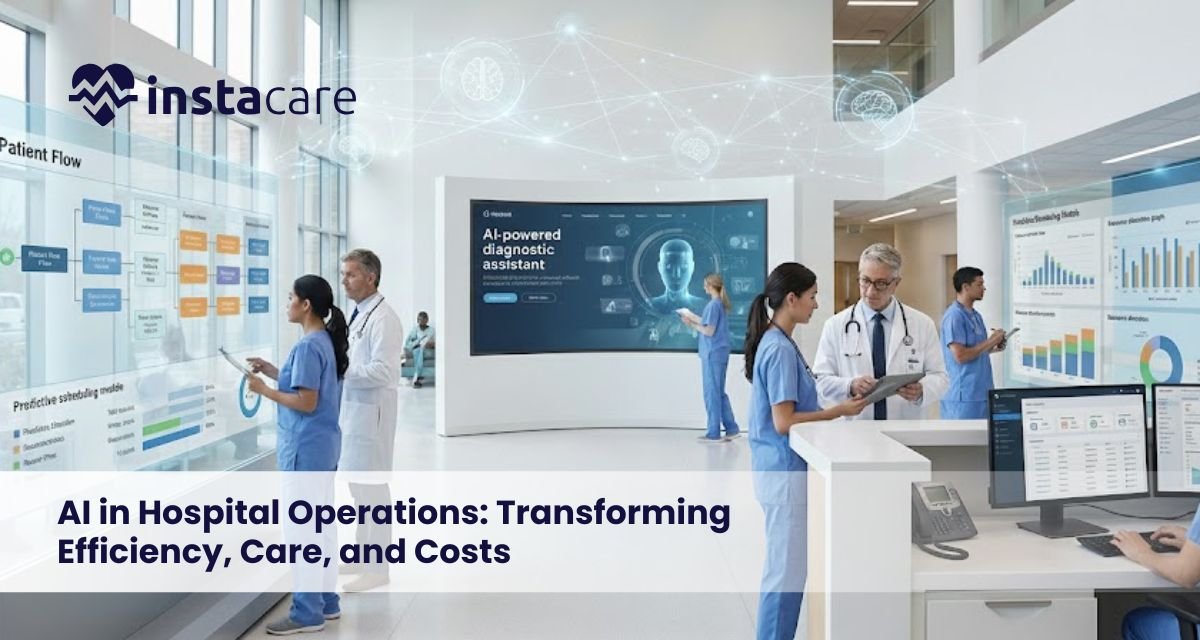
AI in Hospital Operations: Transforming Efficiency, Care, and Costs The current environment in which hospitals operate is highly complicated as it combines the volume of patients, regulatory requirements, shortage of staff, and cost constraints. The conventional models of hospital management cannot scale effectively in such conditions. The adoption of Artificial intelligence in the healthcare sector has been a transformational answer, as hospitals will increase operational effectiveness, clinical results, and regulate the increased spending through automation and intelligence, based on data. What Is AI in Hospital Operations? AI in hospital operations can be defined as the application of superior algorithms, machine learning models, and data analytics in order to optimize the clinical and non-clinical processes in the hospital. In AI in healthcare operations, it uses both structured and unstructured data to identify actionable insights in real-time, using electronic health records, imaging systems, and IoT devices, as well as administrative systems. On the operational level, AI systems act as decision-support engines by improving the planning, prediction, and execution of all hospital departments, allowing them to provide healthcare at a scale and in an intelligible way. Key Areas Where AI Improves Hospital Operations AI has effects on the performance of a hospital at various functional levels and these include: Patient throughput optimization and capacity planning. Scheduling and skillful staffing of the workforce. Computerization of financial operations and billing. Clinical diagnostics and clinical decision support. Supply chain, use of assets. With the help of AI hospital management, organizations will be able to shift to the active and foresight operational control instead of the reactive form. AI in Patient Flow and Resource Optimization When efficiency is poor in terms of patient flow, it causes overcrowding, delays in treatment, and poor use of hospital resources. The AI models can be used to examine the trends of admission, discharge, and the turnaround time of admission diagnoses and availability of staff to streamline inter-departmental flow. Predictive analytics in hospitals allows the prediction of surges, overcrowding of the emergency department, and demand in the ICU. This will enable the administrators to dynamically assign the bed, equipment and staff to enhance throughput without losing quality. Consequently, AI for hospital resource management minimizes waiting durations and idle capacity. AI for Administrative Automation The hospital operating budgets are significantly spent on administrative processes. The automation introduced by AI will deal with the inefficiencies in terms of scheduling, billing, documentation, and processing of claims. Key applications include: Auto-scheduling and reminders of appointment. Smart medical coding and billing validation Clinical documentation Natural language processing. Approval and compliance checks routing. Administrative workloads are decreased through Hospital workflow automation, mistakes are minimized and employees are able to focus on patient activities. Artificial intelligence in healthcare administration helps directly to contain costs and accuracy of compliance. Improving Clinical Decision Support Through AI The sphere of clinical decision-making is becoming more dependent on huge datasets that are beyond the human cognitive limits. AI-powered clinical decision support systems evaluate the history of patients, laboratory values managed through Lab Management Software, imaging outcomes, and clinical guidelines to support physicians in the diagnosis process and planning of treatment. AI for patient care improves the early detection of diseases, diminishes the uncertainty of the diagnosis, and promotes individual treatment courses. Machine learning in healthcare operations not only enhances accuracy in clinical practice but is also operationally efficient when installed in the hospital systems. Benefits of AI in Hospital Operations AI technology implementation provides quantifiable impacts on operations and clinical areas. Key advantages include: Better care coordination and less length of stay. AI-based real-time optimization of the Hospital. Reduced cost of operations through automation and future planning. Less clinician burnout through administrative workloads reduction. Better patient satisfaction and safety results. AI-powered hospital software empowers the performance and resilience of hospital ecosystems by making them data-driven. Book Free Demo Challenges and Limitations Although it has its beneficial aspects, AI implementation in hospitals has significant challenges. Common limitations include: Interoperability limitations and data quality. Complexity of integration with the old hospital systems. Data privacy and regulatory compliance issues. The problem of algorithm bias and model transparency Employee resistance and skills shortage. The absence of strong governance would mean that AI solutions will not be able to enhance operations. Thus, responsible AI in medical administration implementation should include close system validation and constant supervision. Future of AI in Hospital Operations The hospital of the future will trend more on Smart hospital technology, which incorporates AI in the field of clinical layers, operational layers, and infrastructure layers. The modernization of real-time analytics, edge computing, and autonomous systems will allow optimization of its operations at any moment. AI-based hospital optimization will move towards self-learning systems that would make adaptive decisions. AI will assist in predictive maintenance, incorporation of virtual care, and scale population health as part of the larger Digital transformation in hospitals. How Hospitals Can Successfully Implement AI? To effectively implement AI, there must be a plan and gradual process in line with organizational strategy. The major principles of implementation comprise: Creating high-quality data infrastructure that is interoperable. Focusing on use cases that create quantifiable operational impact. Ensuring staff and clinician engagement in deployment. Building AI governance, ethical considerations, and compliance systems. Collaborating with established technology providers and specialists. When applied strategically, AI hospital management will be a long-term service and not an independent technology investment. Conclusion It is no longer an experimental tool but it is an inherent part of contemporary hospital work. Through the incorporation of intelligence into workflows, decision-making, and resource allocation, hospitals will be able to make sustainable gains in Hospital efficiency with AI, quality and financial performance. With the next wave of healthcare systems becoming larger and more complex, AI-based models will characterize the next generation of resilient and patient-centered hospitals. FAQs What does AI do to enhance the efficiency of hospitals? AI enhances productivity by automating operations, streamlining resource allocation, patient demand forecasting, and administrative overload through intelligent data analysis and real-time operational feedback. Is AI safe to be used