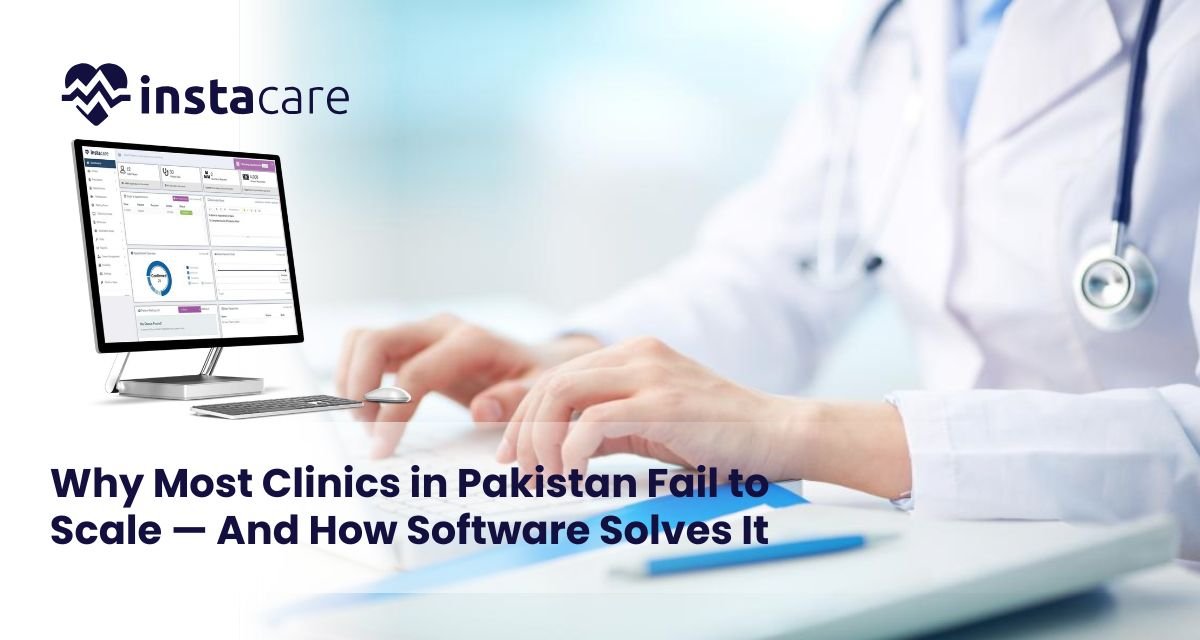
Why Most Clinics in Pakistan Fail to Scale — And How Software Solves It? The rapidly evolving healthcare industry of Pakistan depends heavily on clinics and small medical practices, which provide essential medical care to numerous patients throughout urban and rural areas. These medical facilities treat patients across millions of individuals throughout cities as well as remote areas. Despite performing critical functions, most clinics in Pakistan encounter difficulties expanding their operations past one clinic or doctor location. The expansion of clinics into multi-location healthcare groups remains rare even within densely inhabited areas. Many clinics in Pakistan face growth limitations which leads to a fundamental inquiry about the causes and solutions for this situation. The solution requires an integration of structural problems with business process weaknesses, coupled with weak digital capabilities as the primary reason for growth stagnation. The implementation of digital health record systems and solutions, combined with clinic management software systems, begins to eliminate the barriers that hinder clinic expansion and sustainable scalability. Understanding The Scaling Problem in Pakistani Clinics The objective of scaling a private clinic business exceeds merely extending patient volume across multiple branches. The goal is to develop standardized systems that provide uniform patient care throughout every operational contact point. The majority of clinics in Pakistan battle organizational excellence because of multiple essential factors, and require the best clinic management system in Pakistan 1. Manual Record Keeping and Data Loss Reliable patient documentation records persist on paper at most clinics that operate in the small to mid-sized category. The lack of proper data management produces various problems, which include lost patient history records along with difficult follow-up procedures and increased chances of data loss. Financial expansion through patient data management proves impossible when retrieval capabilities cannot ensure clinical data accessibility. 2. Lack of Operational Visibility The majority of Pakistani clinic owners together with their medical staff operate their clinics without knowing their operational efficiencies. Clinics are effectively making use of the available appointment times. The medical staff manages to follow their scheduled work protocols. What amount of income does the clinic lose through patients who fail to show up and through incorrect inventory management? These important questions remain unanswered because clinics have insufficient monitoring systems. A data-driven strategy is essential for making strategic expansion decisions since the absence of insights will turn important decisions into mere speculation. New clinic branches reflect identical inefficient operational methods from existing facilities, which produce failure instead of growth. 3. Staff Dependency and Lack of Standardization Multiple clinics in Pakistan rely heavily on selected personnel who grasp their operational systems because only these workers enable proper performance. When essential staff members exit, the system fails to function properly. The facilities lack standard operating procedures (SOPs) to train staff and manage flow operations while processing payments. Business expansion depends on standardized operating systems that serve the company beyond individual employees. The absence of automation and enforcement software preserves the fragile and inconsistent operational status of clinics. 4. Financial Leakage and Untracked Expenses Examining monetary movements remains a significant obstacle for businesses trying to expand their medical operations. Several clinics fail to establish proper systems that track both income and expenses, discounts and patient refunds. Petty cash goes unrecorded. Patient payments might be under-reported. The inability to track financial data undermines any possibility of comprehending whether a clinic makes enough profit to grow. The lack of software-backed patient tracking systems results in conflicts about revenue sharing among doctors who share revenue at multi-practitioner clinics. Book Free Demo How Smart Clinic Management Software Solves These Problems? Digital transformation functions across all healthcare institutions, starting from large hospitals to small clinics. A patient management software platform transforms all medical facilities, even in small clinics, through automated operations and improved patient care and data analytics. Here’s how: 1. Automated Appointment Management When patients use clinic software, they can make appointments using a computer or a mobile device options which cuts both telephone congestion and human mistake rates. Software management tools help doctors schedule appointments better so patients obtain their appointments on time, which decreases missed appointments. Real-time updates maintain constant alignment between clinic personnel as well as medical staff. 2. Electronic Medical Records (EMRs) The EMR software for clinics functionality enables clinics to maintain safe storage of patient information including medical records, laboratory reports and clinical prescriptions. The health care quality measures enhance as the system allows patients to keep their medical history accessible across different network doctors or clinics. 3. Centralized Billing and Payments The central billing feature of clinic management software joins all financial operations, including payments and receipt handling together. The software system provides instantaneous transaction recording and report production, and minimises financial loss through cash theft. Seamless payment processing occurs when certain platforms link with POS equipment and digital payment solutions. Benefits of Centralised Billing: Eliminates manual errors Enables transparent revenue-sharing between doctors The software system allows clinic owners to determine their revenue numbers according to service type and department. Patients have better trust in billing processes because items appear separated in statements. 4. Inventory and Pharmacy Management Clinic automation solutions enable clinics with in-house pharmacies to track supply quantities and expiration dates as well as automatically request reorders for consumable materials. The system prevents unnecessary stocking while ensuring essential drugs, together with consumables, remain available during needed. Advantages of inventory automation: Avoids medicine shortages By implementing this measure, expired products cannot reach the market for sale Reduces theft or unaccounted losses The system generates up-to-the-minute evaluations of clinic stock 5. Multi-Branch Management Through software for multi-branch clinics, users can visualise and control various locations through a unified dashboard. Clinic owners gain centralised oversight of all locations’ activities, which include an appointment system along with revenue generation and employee performance tracking, even when they are not physically present. Courting expansion becomes possible for clinics since they gain direct oversight and control across all their new locations. Conclusion Modern medical facilities that will prosper within Pakistan’s changing healthcare environment must begin their
An effective clinic management system is the dire need of the day in today’s world where the healthcare sector is evolving at a very rapid pace. Today, it might be equally challenging to practice in the outdated system and fulfill the requirements and desires of your clinic since technology has advanced a lot. The ways which tell that it is high time to change the clinic management system can help to increase their effectiveness and make patients’ lives better, therefore the clinic’s turnover’s rate will grow in the future. To help, here are ten key indicators that point towards it being time perhaps to think about an upgrade. 1- System Downtime Often Understanding the Issue: That is, if you CMS is constantly experiencing downtimes or technical hitches your clinic would be more severely impacted. Unattended appointments, angry and dissatisfied workers as well as dissatisfied clients are the short-term effects. An upgraded CMS often features better reliability and technical support. This leads to less down time, thus making sure that your clinic is up and running. They are designed to be able to handle high volumes of data and users, so that they do not crash too easily. 2- Poor Workflow Processes Understanding the Problem: Do your employee’s complaints involve a lot of time spent on administrative tasks? And if one’s current system demands a large quantity of data entry, manual work or extended and complex processes then it leads to ineffectiveness or to put it in layman terms, wastes time. Why Upgrade? An upgraded CMS can help streamline workflows, automate repetitive tasks, and improve communication among staff. Electronic prescriptions, automated reminders, and integrated billing can save time and reduce errors. 3- Lack of Integration with Other Systems Understanding the Issue: Integration of your CMS with other systems in the existing interlinked healthcare environment with EHR, billing, and patient engagement tools is something highly important. A standalone would most likely hamper proper flow of communication and sharing of the same. Why Upgrade? A modern clinic management system that possesses robust integration capabilities better aids the workflow. Improvement of patient care, simplified data access, and reports could be achieved through an integration of these. 4- Failure to Generate Reports Explaining the Problem: Producing meaningful reports is critical to tracking clinic performance, analyzing patient demographics, and realizing opportunities for growth. If your existing system hinders the creation of reports or analysis of data, it is probably due time to upgrade. Why Upgrade? An advanced CMS typically provides advanced reporting functionality through which you can customize your reports and know the critical performance metrics. This can be helpful in taking smart decisions for the future of your clinic. 5- Poor Patient Experience Problem Understanding: Patient experience is considered in the current scenario of healthcare. In case the current system creates longer waiting times, missed appointments, or failures in communication, then it will lead to an unsatisfactory experience of the patients. Why Upgrade? A modern CMS can make the patient experience better as it offers features like online appointment scheduling, automated reminders, and secure patient portals. All these tools empower the patient with a lot of powers and enhance overall satisfaction of your clinic. Book Free Demo 6- Unavailability of Data Access through Remote Understanding the Problem: With telehealth and remote working on the rise, your ability to be able to access information from your clinic from anywhere has become crucial. If it is not accessed remotely but only locally, then a system may limit flexibility as well as respond to events. Why Upgrade? There is remote accessibility in the cloud-based management systems, which means people, can operate from anywhere; this promotes productivity and supports the ability for your team to respond to events quickly. 7- Compliance Issues Understanding the Problem: All medical regulations are continually changing and ought to be updated with the best latest CMS standards, for instance HIPAA and other regulations on health privacy. A clinic risk is likely when the compliance with the existing system is below requirement. Why Upgrade? An upgraded CMS will often include features designed to ensure compliance, such as secure data storage, access controls, and automated updates. This can help protect your clinic from potential legal issues and fines. 8- Difficulty in Training New Staff Understanding the Issue: If your current CMS is complicated or not user-friendly, training of new staff is a pretty laborious and painful process. Inefficiency and subsequent decline in performance of a team may occur due to high learning curve. Upgrade: The current CMS system generally keeps usability in mind during design. A user-friendly interface facilitates ease in training new staff who can promptly come into contribution for working at your clinic. 9- Very Limited Options in Personalization Understand the Issue: Each clinic is unique, and your CMS must understand your requirements. If your system today does not allow much personalization, then maybe your workflows or the set of specialties might be severely unsupported. Why Upgrade? Upgrade of CMS often brings personalized features and modules where personalization may help in improving efficiency and, overall user satisfaction. 10- High Maintenance Costs Understanding the Issue: But if the maintenance of a particular CMS is too expensive or requires up-grades very often like to make repairs or technical assistance. Time to Upgrade. Why Should You Upgrade? Upgrades using modern CMSs can even cut long-term maintenance. Many of the updated versions of the systems offer their technical support along with self-serving options so that you hardly need any technical assistance after updates. Conclusion Knowing the telltale signs that it is time to upgrade your clinic management system is essential for ensuring the smooth operation of your practice. A good CMS can help improve the workflows, promote patient experiences, and increase growth in the clinic. From this article, you can make informed decisions regarding upgrading a system and positioning a clinic for success. FAQs 1- How do I select the right clinic management system for my practice? When you are selecting a clinic management system, think about
The Role of Telemedicine in Modern Clinic Management Systems Among other disruptive innovations in recent years, telemedicine has turned upside down the management of clinics and access by patients to interventions. Just think about a patient who can consult with a doctor from the comfort of his house and avoid a long waiting in a crowded waiting room; this is not a dream, it’s the reality developed by telemedicine. Technical requirements of telemedicine develop the opportunity to get integrated into the modern healthcare system through streamlining the services in the clinics. However, there exists a dire need of understanding the concept of telemedicine, benefits, challenges, and thus, what the future holds. Understanding Telemedicine In simple language, it means the use of technology in delivering clinical health from afar. It includes everything from simple consultations on the phone to comprehensive video. This model allows health professionals to access their patients irrespective of their location, which improves their access to medical care immensely. Key Features of Telemedicine Following are some of the key features of telemedicine that go a long distance in improving the patient experience and the functioning of a clinic: Virtual Consultation: The term simply means that one consults his doctor through video calls for convenience, enabling one to get care without necessarily having to make a visit to the clinic. In this regard, remote monitoring will facilitate continuous monitoring of patients suffering from any chronic condition with wearable devices and mobile applications. This also facilitates proactive management of their health. Access to Specialists: Distance would mean little in such aspects as consulting specialists, since it covers distances for patients unable to consult specialists due to geography or other reasons without the added burden of travel. Cost-Effectiveness: The method does reduce travel costs and time for both patients and health professionals; hence, this would be most effectively making healthcare more accessible and time-effective. Integration of Telemedicine in Clinic Management Systems The present-day clinic management system has been designed in order to assist the administrative, patient data, and billing-related tasks to be managed in an organized manner. The integration of telemedicine into the same would tend the clinics to be in a better position in accomplishing functionality on many more counts besides being able to cater to the patients in a better manner. Advantages of Integration Smoothening of operations: Once telemedicine gets integrated into the CMS, appointment scheduling, follow-up of patients, and maintenance of records all become quite smooth and easy. This efficiency frees up more time for the staff since there are less administrative burdens; staff can then be more caring for their patients. Improved Patient Convenience: This in itself improves the experience of patients in seeking home care. One need not worry about long waits in the clinic or taking time off from work. Appointments are easily attended to in comfort. Improved health outcomes: Through regular monitoring and timely follow-ups, telemedicine will offer better management of chronic diseases, reduce hospital admissions, and thus improve health outcomes in general. Data Management: Telemedicine generates a great amount of data; this, integrated with CMS, enables clinics to do better analyses of the patient trends and work toward positive modification of the care protocols for improved outcomes in patients. More Significant Revenue Streams: With telemedicine services, the clinic is afforded the chance to take more patients on board without the use of space. This may lead to increased revenues while catering much-needed care to more patients. Challenges of Telemedicine in Clinic Management Though these benefits are considered significant in number, there have been certain challenges that must be overcome if telemedicine is to find appropriate alignment with clinic management systems. Book Free Demo Compliance and Regulatory Issues Telemedicine faces different regulations that may be very different from region to region. They have to take into consideration a lot of complicated legal issues for clinics to make sure they follow the laws of patient privacy and licensing. This might get particularly tricky for those operating their services across state or national lines. Technology Barriers Not all patients have access to the technology that such services require, let alone reliable connectivity to the Internet. This creates a digital divide in access to care, and for this reason, clinics should begin seeking solutions that will help in realizing equity in the health care provided. Resistance to Change It is generally true that change is quite scary, more so to the health facilities that have been in operation for many years. A few health professions may not embrace the idea of telemedicine because they are conversant with other technologies or have no faith in the technology. Thus, substantial training and continuous support would be required to overcome any such resistance. Quality of Care Concerns Debates are gaining momentum amongst experts whether telemedicine could assure a level of care equivalent to what is received during clinic visits. For that, the clinics need to establish protocols and guidelines that guarantee telemedicine consultations meet high standards of quality in order to maintain the quality of care the patients expect. The Future of Telemedicine in Clinic Management The future of telemedicine in clinic management systems is bright and is going to be shaped by a variety of trends. Artificial Intelligence and Machine Learning AI and machine learning are already being incorporated into the telemedicine platform in the hope of creating an utterly new model of patient care. The technologies analyze massive volumes of patient data, predict health outcomes, and provide personalized care plans. It is a level of sophistication that opens up the possibility of such a service being more efficient and effective. Wearable Health Technology Wearables are increasingly deployed in service to monitor vital signs and health parameters. The integration of such data from wearables into clinic management systems allows practitioners to track patient health status in real-time. This capability allows for timely interventions, thereby improving patient outcomes. More Emphasis on Mental Health However, telemedicine proved to be of particular service in the case of mental health provisions by
Top Clinic Management System – Streamline Operations Are you having trouble managing your clinic operations? The right Clinic Management System will give you the ability to streamline your processes, complete tasks more quickly, and reduce administrative fatigue so that everyone in your office can focus on providing top-notch care. We’ll take you through all the features of our favorite Clinic Management System, what it can do for you and why we think it’s a must-have. Get ready to learn how to save time and money while providing excellent service! Introducing Clinic Management Systems – an overview of what they are and how they can save time and money Managing a clinic requires juggling multiple tasks like scheduling appointments, billing, and maintaining patient records. With the help of clinic management systems, these tasks can be done with ease. A clinic management system is a software that automates the daily tasks of a clinic. From booking appointments to maintaining patient records, everything can be done using a single platform. Not only does it save time, but it also saves money by reducing paperwork and streamlining processes. These systems ensure efficient patient care and reduce the risk of errors. There are many clinic management systems available in the market, so clinics can choose the one that best suits their needs. In summary, clinic management systems are a boon for clinics, helping them provide better care while also saving time and money. Book Free Demo What to look for when selecting the right clinic management system for your office In the midst of running a busy medical office, it can be overwhelming to decide on the best clinic management system for your needs. However, an effective organizing system can be a game changer for your practice. When selecting a clinic management system, it’s important to consider the features that will streamline your workflow and improve patient care. Look for a system that includes tools for staff scheduling, electronic health record management, and a patient portal for appointment scheduling and secure messaging. In addition, ensure that the system is user-friendly and can easily integrate with your current technology. With the right clinic management system in place, you’ll be able to save time, reduce administrative mistakes, and ultimately provide better care for your patients. Advantages of using a clinic management system to improve patient care As the healthcare industry evolves to become more efficient and patient-centric, clinic organizing systems have become an integral part of healthcare facilities. With their advanced capabilities, clinic management systems provide healthcare providers with a comprehensive set of tools to manage patient data, appointments, electronic health records, billing and invoicing, patient communication, and provide real-time analytics. By effectively utilizing a clinic management system, healthcare providers can significantly improve patient care while increasing operational efficiency. Automated appointment scheduling and reminders, patient data management, and seamless communication enable healthcare providers to focus on delivering quality care while maximizing patient satisfaction. Whether you run a small clinic or a large healthcare facility, a clinic organizing system is a must-have to ensure optimal patient care and streamline your operations. View More: Simplifying Record-Keeping with a Patient Record Management System Streamlining operations with automated processes Streamlining operations in any business is a key factor in reducing costs and increasing efficiency. With the advancement of technology, automated processes have become increasingly common in various business sectors. In the healthcare industry, a clinic management system can provide significant benefits in streamlining operations. These systems can automate appointment scheduling, patient information management, billing and insurance claims filing, and much more. By automating these processes, healthcare providers can free up time to focus on providing quality care and improve patient satisfaction. The benefits of a clinic management system are undeniable, and healthcare providers can only benefit from embracing this technology. Benefits of integrating practice management systems to minimize paperwork and errors Managing a practice can be overwhelming, with stacks of paperwork to file and critical tasks to perform while avoiding errors. Thankfully, the integration of practice management systems has revolutionized the approach to managing practices by minimizing paperwork and errors. These systems allow for more efficiency and organization, reducing the time and effort spent on administrative tasks. Patients’ medical information can be easily stored in one location and accessed quickly, streamlining the patient experience and reducing wait times. By implementing a practice management system, practices can save time, avoid errors, and provide their patients with reliable, quality care. Tips for ensuring successful implementation of a clinic management system in your office Modernizing your office’s healthcare record-keeping processes by incorporating a clinic management system is an excellent move. However, it’s not just a matter of installing the system, calling it a day, and assuming that everything will fall into place. Implementation requires strategy and planning to maximize its benefits to patients, healthcare providers, and the practice as a whole. There are several tips that can ensure successful implementation of a clinic management system, including proper training, testing, and gathering feedback from users. With such an approach, your office will be able to operate more efficiently and effectively, leading to improved patient care and ultimately, profitability. Conclusion To recap, investing in a top-tier clinic management system can help streamline overall operations and keep medical facilities efficient. Such a system should include features like appointment scheduling, billing and coding support, practice analytics and more. Furthermore, an ideal CMS will offer secure storage for patient information as well as advanced messaging tools to enable better collaboration with colleagues. By implementing a robust solution for clinic management one can focus on improving patient outcomes while freeing up time that was previously consumed by tedious manual processes. Ultimately, yields can be maximized when clinics rely on the most advanced solutions available – finding an effective CMS makes all of this possible! It’s clear that investing in the right clinical management software pays off – not only for staff but patients as well – with streamlined operations delivered through a comprehensive solution

The Features To Look For In A Clinic Management System In Pakistan When it comes to making sure that you have the most up-to-date and efficient clinic management system in Pakistan, there are a few features that you should be looking for. A good clinic management system can help streamline your business processes and enhance workflow efficiency while also providing secure options for patient data storage and communication. At the same time, this type of technology division helps minimize costs by reducing manual labor requirements. In this blog post, we’ll discuss what makes a great clinic management system in Pakistan as well as provide helpful information about available services on the market today. Read on to learn more! Features of clinic management system in Pakistan Appointment scheduling A clinic management system in Pakistan is an essential tool for any healthcare facility to streamline their daily operations. One crucial feature of this system is appointment scheduling. With the help of appointment scheduling, patients can book their desired appointment time, which decreases the waiting time and enhances the overall patient experience. Moreover, doctors can manage their daily patient appointments through this system, and it helps them to plan their workday accordingly. This feature also helps reduce administrative workload and improves the accuracy of the medical record-keeping process. The appointment scheduling feature in a clinic management system is a valuable asset that enhances patient satisfaction and productivity for healthcare providers. Patient registration In the constantly evolving world of healthcare, a reliable clinic management system has become a fundamental necessity for healthcare providers in Pakistan. One of the essential features of such a system is the patient registration process. This process allows healthcare professionals to capture essential patient information such as demographic details and contact information. It also enables quick and easy identification of repeat patients with a comprehensive patient tracking system. Patients are also provided with unique identification numbers, which help healthcare providers to efficiently track patient visits, test results, and treatment progress. Overall, an efficient patient registration system is crucial for the smooth and effective functioning of a healthcare facility, providing an excellent patient experience while improving clinical outcomes. Book Free Demo Electronic medical records (EMR) Clinic management systems (CMS) in Pakistan have revolutionized the way medical records are maintained by healthcare providers. The Electronic Medical Records (EMR) feature, in particular, allows for patient data to be recorded and stored in a digital format, eliminating the need for paper-based record-keeping. This not only helps in reducing errors but also enables healthcare professionals to access patient information instantly. EMR also enables patients to view their medical records online, making it easier for them to keep track of their health and treatment progress. The implementation of EMR in CMS has made healthcare in Pakistan more efficient and reliable and has contributed to improved patient outcomes. cloud-based setup and ease of use Clinic management system is an innovative solution that streamlines the daily operations of medical facilities across Pakistan. The cloud-based setup enables easy access to patient records, scheduling appointments, and billing, eliminating the need for physical storage or paper-based systems. The ease of use is a bonus, making it accessible to even the non-tech-savvy staff members with minimal training. The software also offers customizable templates that cater to the specific needs of medical professionals. Overall, clinic management systems have transformed how medical facilities operate, resulting in improved patient care and increased productivity. Identify the need for secure data storage and patient privacy As technology continues to advance, a clinic management system in Pakistan becomes a desirable solution in streamlining operations and ensuring efficient patient care. When implementing any such system, a critical consideration is secure data storage and patient privacy. Important data shared by patients and healthcare service providers must be safeguarded against theft, loss, or manipulation, and this responsibility rests with the clinic management system. Additionally, patient privacy should be maintained to uphold an ethical and professional standard of care. Therefore, a management system that goes the extra mile to ensure secure data storage and patient privacy is a worthy investment for healthcare providers in improving their sector’s practices and facilitating a safer healthcare environment. Consider the availability of different payment methods Clinic management systems have become increasingly prevalent in Pakistan’s healthcare industry, providing a range of features that facilitate decision-making, administration, and patient satisfaction. One of the most significant advantages that these systems offer is the availability of multiple payment methods, enabling patients to pay for their healthcare using cash, credit/debit cards, or through online transfers. This not only makes the payment process more convenient for patients but also benefits healthcare providers who can now manage their finances more efficiently. Other notable features of these systems include medical records management, appointment scheduling, inventory management, and staff management. Overall, the implementation of a clinic management system in Pakistan brings numerous benefits for healthcare providers and patients alike, making medical facilities more organized, efficient, and accessible. Billing and invoicing One of the key features of clinic management systems in Pakistan is billing and invoicing. These systems are designed to facilitate the billing process by automating various tasks such as generating invoices, sending payment reminders, and recording payments. Additionally, clinic management systems offer real-time data on billing and payments, allowing healthcare providers to track their revenue streams effectively. This feature is particularly beneficial for clinics that often struggle with financial management due to manual billing processes that are prone to errors and inconsistencies. With a clinic management system in place, billing and invoicing become a streamlined and hassle-free process, allowing healthcare providers to focus on providing quality care to their patients. Inventory management Clinic management systems in Pakistan offer various features to streamline operations and enhance efficiency in healthcare settings. One of these features is inventory management, which enables clinics to keep track of their stocks of medications, equipment, and other supplies. With inventory management, clinics can monitor stock levels, receive alerts when items run low, and place orders before supplies run out. This

5 Tips To Improve Clinic With Clinic Management System Software Are you looking for ways to make your clinic more efficient? Use clinic management system. Are you tired of inefficient workflow and long wait times, or are you new to managing a medical office and looking for ways to streamline the process? Either way, there’s never been a better time than now to start improving clinic efficiency. In this blog post, we’ll explore five tips for making your healthcare facility run smoother and faster. From improved patient communication strategies to smarter staff scheduling practices, these suggestions will help make sure that every visit is as timely and comfortable as possible. Read on to discover how implementing small changes can lead to big improvements in your clinic operations with clinic management system! Tips To Improve Clinic Efficiency Streamline Patient Registration By Using Electronic Forms Patient registration can be a long and frustrating process, especially for healthcare providers who may be overwhelmed with paperwork. But there is a solution – electronic forms. By using electronic forms, patients can complete their information online before arriving for their appointment, saving time and reducing errors. Electronic forms also allow for easy integration and storage of patient data, making it readily accessible for providers during appointments and ensuring accuracy in patient records. With the growing use of technology in healthcare or clinic management system, electronic forms are becoming more widely adopted and are a valuable tool for improving the patient experience and streamlining administrative tasks for healthcare providers. Book Free Demo Utilize A Secure Electronic System To Store And Access Patient Records In today’s fast-paced world, healthcare providers must be able to access their patient’s records quickly and securely. The utilization of a secure electronic system for patient record storage and access is an excellent way to ensure that patient information is accurate and up-to-date. Not only does an electronic system allow for easy access to patient records, but it also ensures that sensitive patient information is kept private and confidential. This type of system also allows for more efficient communication between healthcare providers, leading to better overall patient care. By utilizing a secure electronic system, healthcare providers can ensure that their patients receive the best care possible while maintaining the highest level of confidentiality. Schedule Appointments Online To Reduce Waiting Times As our lives become increasingly busy, the traditional method of scheduling appointments by phone can be a hassle. Fortunately, you can now schedule appointments online, saving you both time and energy. By utilizing this technology, you can circumvent long wait times on hold or on the phone, and instead quickly find availability that works with your schedule. This efficient system not only benefits you, but it also helps businesses by reducing the burden on administrative staff. So, the next time you need to schedule an appointment, consider using an online system like clinic management system and enjoy the ease of booking at your convenience. Develop Workflow Templates To Help Staff Quickly Complete Routine Tasks Wouldn’t it be nice if your team could complete their routine tasks in half the time it currently takes them? Creating workflow templates can do exactly that. These templates can serve as a guide for employees to follow step-by-step, ensuring they don’t miss important steps. It’s a simple solution that has the potential to greatly increase productivity and save valuable time. By taking the time to develop and implement these templates, you’re setting your team up for success. Not only will they be able to complete their tasks quicker, but they’ll also be more consistent and accurate in their work. Overall, investing in workflow templates is a smart move for any organization looking to streamline their processes. View More: Why Your Clinic Needs A Clinic Management System Invest In Technology That Automates Administrative Tasks Investing in technology like clinic management system that automates administrative tasks can be a game-changer for medical practices. With the latest advancements in technology, billing, document preparation, and follow-up communication with patients can be streamlined and simplified. The benefits of automation go beyond just saving time and reducing errors. It can also lead to improved patient satisfaction and better patient outcomes. Patients value receiving timely and accurate information and having a smooth and timely payment process. By implementing automation, medical practices can focus on delivering high-quality patient care and leave administrative tasks to machines. Overall, investing in technology for administrative tasks is a win-win for both the practice and the patients such as clinic management system. Conclusion After reading through the five tips to improve clinic efficiency, you’ve learned how critical it is to create systems that streamline communication, reduce unnecessary tasks, and make use of process automation. You now understand the importance of having visibility into your data as well as managing staff and patient expectations. Ultimately, these tips can help you get the most out of every minute in your day. By increasing efficiency, you can stay on top of new growth opportunities while maintaining top-notch customer service at all times with the clinic management system. Whether it’s eliminating redundant workflows or ensuring patient safety, implementing processes for clinic efficiency is essential for success. With the right strategies in place and a top-down attitude toward building an efficient clinic, you should be well on your way to achieving long-term financial and operational triumphs!

Why Your Clinic Should Go Paperless With Clinic Management System? Are you still using pen and paper to manage patient records in your clinic? If so, then you’re likely aware of the time-consuming nature of paperwork with all its manual data entry tasks. But did you know that going paperless can help dramatically reduce administrative work for your staff. As well as create a more secure environment for patient data? Achieving full digital documentation offers or clinic management system numerous medical benefits – from streamlining paperwork processes to helping prevent costly medical errors and ensuring faster care delivery. Making it a worthwhile venture for any healthcare practice. In this blog post, we’ll provide an overview of why your clinic should go paperless and explain how digital document storage provides powerful advantages when compared to traditional recordkeeping methods. Overview of paperless systems Paperless systems have become increasingly popular in recent years as organizations look for ways to streamline their operations and improve efficiency. By eliminating the need for paper-based processes, companies can save time and money while also reducing their environmental impact. Clinic management system systems allow for the seamless transfer of information between departments and can be accessed from anywhere with an internet connection. Additionally, the use of paperless systems can help to reduce errors and increase data security. As technology continues to advance, we can expect to see more companies making the switch to paperless systems in the coming years. Benefits of paperless systems As we progress towards a more environmentally conscious world, choosing a paperless system is one of the most significant steps in the right direction. There are several benefits of digital documentation or clinic management system that not only help the environment but also make work more manageable. For starters, it’s easier to search and find documents by using keywords instead of manually sifting through mountains of paper. Furthermore, digital systems take up less space, enhancing office productivity by freeing up space traditionally used for paper storage. Paperless systems also reduce the likelihood of data loss through wear and tear and help save on printing costs. By making the switch to paperless systems, you’re not only helping the environment, but you’re also simplifying everyday work processes. Book Free Demo An explanation of the various technologies available for clinics to go paperless As technology continues to evolve, so do our healthcare systems. One aspect that has seen significant changes in recent years is the move towards paperless clinics. Electronic Health Records (EHR) is one technology that clinics can utilize to go paperless. EHRs offer a secure and confidential way for healthcare providers to document patient care electronically. In addition to EHRs, voice recognition technology can also be used to update patient records in real-time, making documentation more efficient and accurate. Another option for clinics is electronic prescribing, where medications are ordered and sent directly to the pharmacy from the provider’s computer. This eliminates the need for paper prescriptions, making the entire process faster and more efficient. By going paperless, clinics can not only reduce their impact on the environment but also improve patient care by streamlining processes and reducing errors. How a paperless system can help improve patient care and satisfaction As the healthcare industry continues to evolve, paperless systems are becoming more prevalent in hospitals and clinics. By using electronic records or clinic management system, medical staff can access patient information quickly and easily, leading to improved patient care and satisfaction. Without the need to shuffle through stacks of paper, doctors and nurses can get a comprehensive view of a patient’s medical history and make informed decisions about their treatment. This streamlined approach can also reduce errors and save time, allowing staff to spend more time with patients rather than on administrative tasks. Additionally, patients often appreciate the convenience of electronic communication and digital access to their medical records. Overall, transitioning to a paperless system can be a significant step towards better patient care and satisfaction. Advantages of using digital records, including cost savings and improved accuracy In today’s digital age, the use of digital records has become increasingly popular due to its numerous advantages. One of the most significant benefits of using digital records is the cost savings it offers. Unlike traditional paper records, digital records eliminate the need for expensive storage space, printing costs, and the cost of physically transporting files from one location to another. Moreover, clinic management system promote improved accuracy as they are easily searchable, trackable, and can be accessed anytime, anywhere. This makes it easier to find and retrieve the information required quickly, without the need for endless searching through paper files. Overall, the use of digital records is an intelligent investment as it saves time, and money, and enhances accuracy in information management. How a paperless system can reduce office clutter and streamline administrative processes In today’s digital age, many businesses are shifting towards a paperless system to reduce office clutter and streamline administrative processes. A paperless system is not only environmentally friendly, but it also saves workspace and eliminates the need for expensive filing cabinets and storage space. By going paperless, businesses can easily access their data and documents with just a click of a button, making their administrative operations more efficient and less time-consuming. Additionally, a paperless system also reduces the risk of lost, damaged, or stolen documents, ensuring that important information is always safe and secure. Overall, making the switch to a paperless system is an excellent way for businesses to simplify their administrative processes and reduce the clutter in their offices. View More: What is Patient Record Management Software? Tips for transitioning to a paperless system in your clinic, including training staff and handling data security concerns Transitioning to a paperless system can be daunting, but it can make a significant difference in your clinic’s workflow. The key to success is to train your staff adequately and to address any data security concerns. When it comes to training, be sure to invest time and resources
The Benefits Of Using A Clinic Management System In Pakistan Are you a healthcare provider in Pakistan looking for ways to make running your clinic more efficient and cost-effective? If so, then implementing a clinic management system in Pakistan might be the right solution for you. A CMS is beneficial for health care providers as it provides an all-in-one, centralised database that stores patient information such as medical records and billing data. This complete electronic record allows clinicians to quickly access and manage patient files with ease; reducing operational costs, errors and paperwork. Not only does this improve the overall efficiency of the practice but also delivers better quality of care to patients by streamlining the appointment booking process, tracking treatment plans and providing real time communication between different departments. In this post we’ll explore how a clinic management system in Pakistan can benefit clinics operating in Pakistan. Streamlines administrative tasks In today’s fast-paced world, clinics need to keep up with the times to ensure efficient and effective healthcare delivery. Implementing a clinic management system is a step in the right direction. Not only does it streamline administrative tasks, but it can also assist in managing appointments, billing, and patient records. The benefits of a clinic management system in Pakistan are particularly relevant in Pakistan, where the healthcare system is often overburdened and understaffed. With a system in place to manage routine tasks, doctors and nurses can focus more on the care and treatment of their patients. In addition, patients themselves can benefit greatly from a more organized system, as it will result in reduced wait times and shorter processing times. All in all, the implementation of a clinic management system can ultimately lead to better healthcare outcomes for everyone involved. Improves patient care A clinic management system in Pakistan can significantly improve patient care in many ways. With the implementation of a system, healthcare professionals can easily access patient records, including medical history, allergies, and medication. This system can also efficiently manage appointment scheduling, reducing waiting times and improving patient flow. Moreover, a clinic management system can aid clinicians in providing accurate diagnoses and treatments by providing real-time access to patient data. As a result, patients can receive faster and more efficient healthcare services that significantly improve their quality of life. With the help of technology, healthcare providers can focus more on delivering high-quality care while reducing administrative tasks. In turn, this allows them to devote more time to their patients and provide better patient care. Enhances communication With the increasing demand for healthcare services in Pakistan, the need for effective communication channels within the healthcare system becomes crucial. Fortunately, the implementation of clinic management systems has made it possible to streamline communication processes in healthcare institutions. By offering a centralized platform for healthcare professionals to share patient information, treatment plans, and test results, clinic management systems minimize the risk of miscommunication and errors. In turn, this has helped healthcare professionals to provide more efficient and accurate diagnoses and treatment plans to their patients. Therefore, it is essential for healthcare institutions to embrace the use of clinic management systems to enhance communication, improve patient outcomes, and ultimately, save lives. Book Free Demo Increases efficiency Investing in a clinic management system can bring forth a myriad of benefits for healthcare providers in Pakistan. One of the most notable advantages is the increase in efficiency. With a clinic management system, medical practitioners can streamline various processes, from appointment scheduling to patient data management, with ease. This eliminates any manual tasks that could slow down the clinic’s operations and ensures that the focus remains on the patients’ needs. Additionally, the system can generate reports, monitor inventory, and streamline billing, saving the clinic staff valuable time and resources. Ultimately, implementing a clinic management system can go a long way in boosting the overall efficiency of a healthcare facility in Pakistan. Improves financial management A clinic management system in Pakistan can bring about numerous benefits for the healthcare sector in Pakistan. An essential advantage that comes with such a system is improved financial management. With a clinic management system, all financial transactions can be recorded and tracked accurately with minimal errors. This reduces the possibility of any financial discrepancies and improves cost-effectiveness. The system can generate reports that enable healthcare providers to measure the performance of their business, such as revenue and expenses. Such data can help in making informed decisions about future investments or cost-saving measures. Thus, adopting a clinic management system can go a long way in streamlining financial management and allowing healthcare providers to focus on delivering the best possible care to their patients. View More: What is Best Medical Software For Doctors In Pakistan? Provides data analysis Implementing a clinic management system in Pakistan can bring numerous benefits that can streamline and optimize the healthcare delivery process. One of the most significant advantages is the ability to gather data and perform analysis. With digital systems in place, clinics can capture and store patient data, administrative files, test results, and more. This information can be used to create detailed reports and insights, allowing healthcare providers to identify trends and patterns. In turn, this analysis can lead to better decision-making and informed strategy planning for efficient resource allocation. By taking advantage of the power of data analytics, clinic management system in Pakistan can improve their operational efficiency and ultimately provide better care for patients. Conclusion Overall, it is important for clinic management system in Pakistan to understand the benefits of using a clinic management system. Such systems can help to automate common processes, from bookings and appointments to orders, invoices, and payments in Pakistani facilities. By managing these various components more efficiently, clinics benefit from reduced costs, enhanced performance and data accuracy, better patient care and convenience overall. In addition, clinic managers are able to assess the needs and wants of their customers with greater speed through data analytics offered by modern medical software providers. Clinics that employ such systems observe
How To Choose The Right Clinic Management System For Your Clinic In Pakistan? Are you a healthcare provider looking for the most efficient and cost-effective way to manage your clinic in Pakistan? In recent years, the rise of technology has made it easier than ever to have an entire medical management system at your fingertips. But with so many choices out there, how can you be sure which clinic management system is right for you? In this blog post, we’ll explore the factors that should go into making your decision so that you can make an informed choice when choosing the best clinic management system for your needs. We’ll take a look at common features such as patient records, appointment scheduling systems, payment processing capabilities, and more – all designed to streamline workflows and save time throughout the administrative process. Read on to learn how to find the perfect clinical software solution tailored just for Pakistani clinics! Understand the needs of your clinic What kind of services do you offer, how many staff members are there, etc. In order to effectively manage your clinic, it’s important to have a thorough understanding of its needs. This includes knowing what types of services you offer, how many staff members are on board, and any special requirements or resources that may be necessary. By taking the time to carefully assess these factors, you can ensure that your clinic is equipped to handle the demands of both patients and employees, and that you’re able to provide the highest level of care possible. Whether you’re just starting out or looking to improve your operations, understanding your clinic’s needs is an essential first step. Research the different types of clinic management system available in Pakistan In today’s world, clinic management systems have become an essential part of the healthcare industry. As you research the different types available in Pakistan, you will find that each system has its unique features and capabilities. Some offer advanced inventory management, while others provide e-prescription and billing. Additionally, many clinic management system offer appointment scheduling, patient information management, and detailed analytics for a better understanding of your clinic’s performance. By comparing these systems, you can find the most suitable one for your clinic’s specific needs. With the right clinic management system, you can improve your clinic’s efficiency and streamline your day-to-day operations. Book Free Demo Determine your budget The cost of the system may vary depending on your particular needs. When it comes to choosing a security system, it’s important to determine your budget and assess your needs. Depending on your particular requirements, the cost of the system may vary. Factors such as the size of your property, the number of entry points, and the level of surveillance required can all affect the overall price. It’s important to consider the long-term benefits and potential cost savings of investing in a quality security system. While it may seem like a significant expense upfront, the additional peace of mind and protection for your property can ultimately be invaluable. By working with a reputable security provider and discussing your options, you can find a system that fits both your needs and your budget. Look for user reviews to get an idea of customer satisfaction with a particular system When looking to purchase a new clinic management system, it’s important to gather as much information as possible to make an informed decision. One useful source of information is user reviews. These reviews provide firsthand accounts of the system’s capabilities, ease of use, and overall satisfaction. It’s important to not only look at the overall rating but also read through a variety of reviews to get a better understanding of any potential issues or strengths. By taking the time to research user reviews, you can feel confident in your decision and ensure that you are choosing a system that will meet your needs and exceed your expectations. Consider whether or not you need a cloud-based or local system In today’s digital age, businesses are presented with a plethora of options when it comes to choosing a clinic management system to manage their data. One question that arises is whether a cloud-based or local system is the way to go. While a local system has the advantage of being physically accessible and can operate without internet connection, a cloud-based system offers remote accessibility and the luxury of being able to access the data from anywhere with an internet connection. It ultimately depends on the specific needs of the business and the level of control and security they require over their data. Regardless of the choice made, it is important to carefully weigh the pros and cons of each option before making a decision. Identify any specific features you require such as medical records integration, appointment scheduling, billing systems, etc. When selecting a new clinic management system for your medical practice, it is essential to carefully consider all of the features that you require. These specific features may vary from practice to practice, but they can include capabilities such as medical records integration, appointment scheduling, billing systems, and more. With the right software in place, you can streamline your operations, improve patient care, and increase overall efficiency in your practice. So, take the time to identify the key features you need and choose a product that can meet all of your needs, both now and in the future.

Why Your Clinic Needs A Clinic Management System In Pakistan? As a clinic owner or operator in Pakistan, it can be hard to keep up with the ever-changing demands and modernizing healthcare industry. It can feel like there is no time for important tasks such as taking care of your patients and making sure that their needs are met in an efficient manner. In order to manage these ongoing challenges, many clinics have turned to utilize the clinic management system in Pakistan (CMS). Clinic management systems offer you the opportunity to remain organized while providing quality patient care at the same time. Here we will discuss why your clinic needs a CMS, how they work, as well as what benefits it could bring your practice. A Clinic Management System (CMS) provides efficient patient care and streamlines operations In today’s fast-paced healthcare environment, delivering efficient patient care has become the cornerstone of every medical facility. To cater to this ever-growing demand, a Clinic Management System in Pakistan has emerged as a game-changer in the healthcare industry. By organizing the patient data in a centralized electronic repository, this system enables healthcare providers to streamline their operations, minimize redundancy, and improve overall efficiency. With the help of a Clinic Management System, healthcare professionals can also access patient records easily, manage appointments and schedules, track billing and payment, and provide billing and payment updates in a timely and efficient manner. Overall, adopting a Clinic Management System can significantly enhance the quality of patient care and enable medical providers to deliver optimal treatment results. A CMS allows doctors and staff to easily access patient records and provide quality healthcare services A clinic management system in Pakistan is a software that enables medical staff to easily access, manage, and share patient records. With this system in place, doctors and their teams can deliver quality healthcare services to their patients. The CMS simplifies time-consuming administrative tasks such as scheduling appointments, managing patient medical history, and billing. By doing so, medical staff can focus on providing personalized care and attention to their patients. CMS also helps in maintaining confidentiality of patient information, making it easier to comply with HIPAA regulations. With the growing need for efficient healthcare services, a Clinic Management System is becoming a vital tool in the medical industry. Book Free Demo A CMS helps increase efficiency by automating administrative tasks A CMS, or Clinic Management System, is an essential tool that helps healthcare providers to automate their administrative tasks such as appointment scheduling, billing, and medical record management. This tool is specifically designed to increase efficiency in healthcare facilities by eliminating time-consuming manual processes that can hinder productivity. With a clinic management system in Pakistan, healthcare providers can easily manage their patients’ health records, keep track of appointments, and streamline their billing processes, all in one platform. By automating these tasks, healthcare providers can free up their valuable time, enabling them to focus on more important matters, such as providing quality healthcare to their patients. A CMS enables secure data sharing between doctors, nurses, and other medical personnel In the fast-paced world of healthcare, effective communication is critical to delivering top-quality care. Collaboration between doctors, nurses, and other medical personnel is essential to promote speedy recovery of patients. However, sharing critical information can be a daunting task in a complex and highly regulated industry. A Clinic Management System In Pakistan, or content management system, is a valuable tool that enables secure data sharing between healthcare professionals. A CMS makes sharing information between disparate systems simple and secure, ensuring that everyone involved in patient care is on the same page. As a result, patients receive timely and accurate care in a safe, efficient, and cost-effective manner. View More: How Patient Management Systems are Transforming Healthcare in Pakistan? It provides a secure platform for medical data storage & retrieval Medical data storage and retrieval is a critical aspect of modern healthcare. With the need to maintain the confidentiality and security of patient information, it is essential to have a platform that offers a secure system. Fortunately, there are systems that have been designed specifically for this purpose. These systems provide the perfect solution for healthcare providers, enabling them to store and retrieve data easily, quickly, and securely. The information can be accessed from anywhere, which offers added convenience to doctors, nurses, and other healthcare professionals. With this platform, healthcare providers can rest assured that patient information is kept confidential, secure, and easily accessible when needed. A CMS simplifies the process of tracking patient progress through Electronic Health Records (EHRs) A CMS or Clinical Management System is an essential tool for healthcare providers to streamline the process of tracking patient progress through Electronic Health Records or EHRs. With the use of a CMS, healthcare providers are able to easily access patient information, track their treatment progress, and record any changes in their medical history that might occur. This allows for a more efficient and effective treatment process, as providers can quickly identify any potential issues or concerns and adjust treatment plans as needed. Additionally, a clinic management system in Pakistan can help to reduce errors and improve patient outcomes by providing a comprehensive view of a patient’s health history and treatment plan. Overall, the use of a CMS is critical for healthcare providers looking to enhance patient care and improve clinical outcomes.
- 1
- 2