

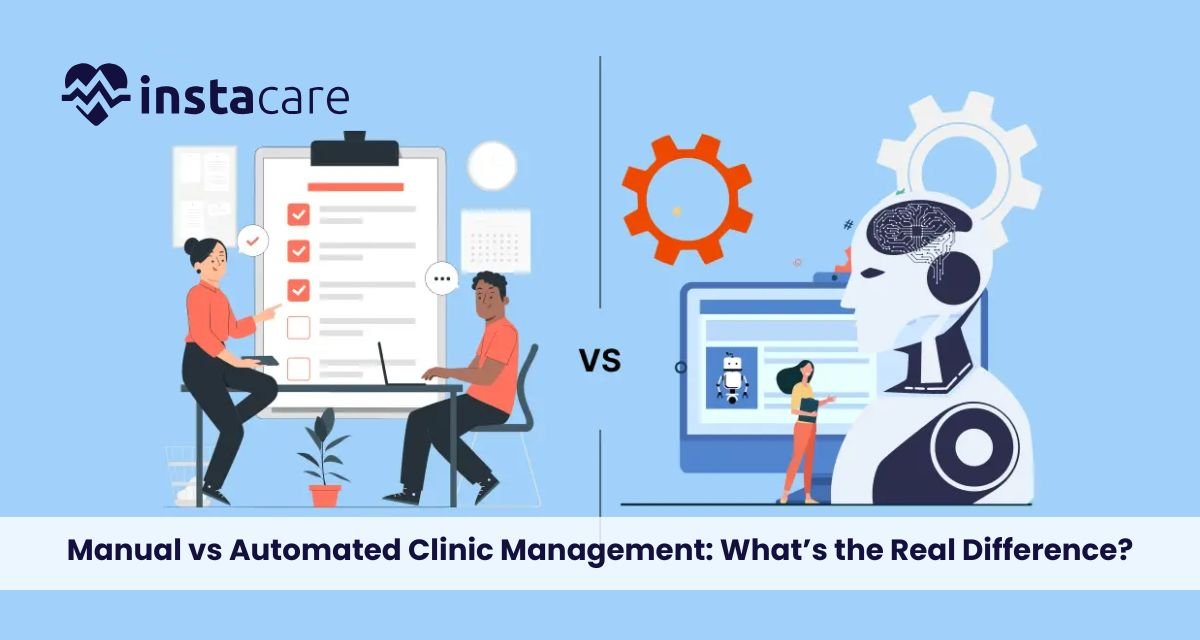
Manual vs Automated Clinic Management: What’s the Real Difference? Much has been written about Manual vs Automated Clinic Management as health facilities seek to optimise administrative costs and improve patients’ welcomes. Most clinics typically rely on manual systems such as paper records and human input for administrative tasks. However, means have developed over the last years with many modern systems that automate processing and provide other benefits that can radically change a clinic’s operations. Thus, healthcare providers must understand the distinction between the two to better manage themselves. The Manual Clinic Management Manual clinic management generally implies practices that have been basic for healthcare administration for many decades. It usually means using paper files, handwritten notes, and manual scheduling systems. These methods might have performed their functions; however, they leave much to be desired in their drawbacks, which can hinder clinic operation efficiency and patient care. Time-Consuming Task Patients’ medical records are stored in physical files manually, making recovery time-consuming and, in most unfortunate cases, the a danger of losing or destroying files. Also, introducing human input into data entry has created a health risk environment that establishes a high disorder or error state in patient information. Such symptoms contribute to a poorer workflow, severely affecting patient satisfaction and the entire clinic’s performance. Administrative Effort They often require a lot of administrative effort, which clinic staff invest almost all their working time into, eventually leading to an inevitable diversion from patient-centred activities. Such experiences are the precursors of burnout among healthcare workers, impacting the quality of patient services. Such gaps in clinic management will become glaringly visible as changes in the healthcare sector continue shaping demand for better alternatives. Understanding Automated Clinic Management On the other hand, automated clinic management software depends largely on different kinds of digital systems to optimise the efficiency and accuracy of various processes in healthcare settings. Electronic health records (EHR), billing systems, and appointment scheduling tools are automated systems designed to facilitate a perfect run of course in the management of a clinic. Professional Patient History With automated systems, professional patient history is stored in digital form; thus, it can be accessed quickly and securely for authentication. It reduces time consumption in carrying out administrative tasks and also reduces human errors related to manual data entry. For example, automatic systems can ensure that patient folders are updated with treatment work readily available to health professionals, enabling them to make immediate decisions. To Increase Efficiency In The Workflow Furthermore, automated systems are often equipped with techniques to increase efficiency in the workflow. For example, reminders can be set up to alert staff concerning upcoming appointments, follow-ups needed, or critical billing deadlines, which helps reduce the chances of missing assignments. Such an organisation cultivates a more cohesive working environment so that healthcare professionals can devote their attention to where it truly matters: patient care. Advantages of Automated Clinic Systems When considering the benefits of automated clinic systems, it is found that these are just some of the solutions through which most manual management problems can be addressed. Such change does bring modernisation to the ruins of a clinic; however, the transition from paper to digital introduces the following significant changes. Improved Efficiency Improved overall efficiency is by far the greatest benefit of automated clinic management. In effect, automating routine stuff streamlines working processes within the clinic and, in this manner, enables clinicians to spend more time talking to their patients instead of doing administrative work. This results in speedier processing of patients and a more organised approach to managing appointments and records. Automated scheduling systems enable patients to make appointments online, relieving the administrative staff from extra burden and reducing scheduling conflicts. This adds convenience to the patient’s experience and helps clinics optimise their schedules to better allocate their resources. Reducing Errors Reducing errors is another important advantage of automated systems. Automatic systems eliminate the possibility of human error at this stage as far as data entry is the outcome being wrong. But above all that, automatic systems always include built-in checks and balances that notify potential errors long before they become an issue. For example, if a health provider tries to enter different information, the computer can output an alert, allowing immediate correction. This level of oversight is immensely valuable for the precision of patient information, as well as ensuring that healthcare providers will have accurate information available for their patients. Enhanced Patient Experience Apart from this, automated clinic management systems also contribute to a much better patient experience. Features such as easy online appointment scheduling and secure portals for patients will increase the flexibility of healthcare activities. These will empower patients since they can now manage more on their own, such as gaining access to their medical records, seeing the outcomes of tests, and communicating directly with their healthcare providers. From A Paper-Based Management System to an Automated Shifting from a paper-based management system to an automated one may be intimidating; however, clinics have succeeded in this transition. A transition becomes successful with careful planning and good execution. These clinics should begin as far away from the final implementation as possible in evaluating existing workflows for situations that most deserve automation. This could include administrative processes, management of patient data, or billing practices. After recognising the areas that require improvement, clinics can then choose suitable software products based on those needs. It becomes important to involve the staff in this phase, as their input may give very relevant context to the selection of systems that will work best. Following this, training the staff on the new technology becomes very important so that everyone feels good and can use the automated tools in their work. Follow system implementation with ongoing support and feedback possibilities to keep improving. As the staff becomes increasingly comfortable with the automated processes, clinics can optimise the potential of their new systems and reap the benefits of enhanced efficiency and fewer errors. Digital Healthcare Management With healthcare constantly evolving, digital healthcare
What You Must Know About Digital Disruption In Healthcare? Mechanized aggravation has transformed into an in vogue articulation in various organizations, and clinical consideration is no extraordinary case. The joining of cutting edge developments might conceivably change how clinical consideration is conveyed, dealing with open minded results, further developing efficiency, and modifying the patient experience. In this article, we will explore the imperative pieces of mechanized aggravation in clinical consideration and its impact on the business. The Contribution Of Telemedicine By working with distant counsels among patients and medical services experts, telemedicine has reformed medical care. Without the requirement for in-person visits, patients can get clinical guidance, analysis, and treatment through video conferencing and other correspondence advances. This innovation is particularly useful for individuals who live in country regions and might not have simple admittance to medical care administrations. It in like manner further creates convenience for patients with flexibility issues or individuals who find it attempting to make an outing to clinical benefits workplaces. Distant Patient Checking With Digital Disruption In Healthcare Far off quiet checking includes the utilization of wearable gadgets and sensors to gather patient information beyond conventional medical services settings. These gadgets can follow imperative signs, for example, pulse, circulatory strain, and glucose levels, as well as movement levels and rest designs. The gathered information is communicated to medical care suppliers continuously, permitting them to remotely screen patients’ wellbeing. This innovation is particularly important for overseeing ongoing circumstances, as it empowers early discovery of likely issues and takes into account opportune mediations. In rundown, digital disruption In healthcare and far off quiet observing are huge progressions in computerized disturbance in medical services. Telemedicine gives remote admittance to medical care administrations, further developing availability and accommodation for patients. Distant patient observation permits medical care suppliers to gather and screen patient information from a distance, upgrading the administration of constant circumstances and empowering early mediation. These innovations can possibly change medical care conveyance, making it more open, productive, and patient-focused. Developed Information Exactness The change from paper-based clinical records to electronic wellbeing records (EHRs) has fundamentally further developed information precision in medical care associations. With EHRs, medical services suppliers can enter patient data straightforwardly into a computerized framework, decreasing the gamble of blunders that can happen during manual recording. This guarantee that patient information is recorded precisely, prompting more dependable and thorough clinical records. Book Free Demo Improved Data Sharing EHRs work with consistent data division among medical services suppliers, further developing coordination and congruence of care. Sharing patient data across various healthcare settings can be time-consuming and error-prone with paper-based records. EHRs empower approved medical care experts to get to patient records electronically, taking into consideration a more effective trade of data. This upgrade coordinated effort among medical services groups, prompting better-educated navigation and working on tolerant results. Smoothed Out Work Process And Effectiveness The reception of EHRs has smoothed out the work process and further developed productivity in medical care associations. With advanced records, medical care suppliers can rapidly recover patient data, killing the need to look through piles of paper documents. This recovers time and permits medical services experts to zero in more on quiet consideration. Additionally, digital disruption In healthcare, reducing paperwork and increasing overall efficiency. Improved Patient Security EHRs add to upgraded patient security by diminishing the gamble of mistakes and further developing drugs across the board. With computerized records, medical care suppliers can undoubtedly get to a patient’s finished clinical history, including sensitivities, past conclusions, and meds. This data forestalls medicine mistakes, for example, endorsing prescriptions that might collaborate adversely or cause unfavorable responses. EHRs also help clinical decision support systems by alerting healthcare providers to potential drug interactions or dosage errors and reminding them to avoid them. Information Examination And Populace Wellbeing Digital Disruption In Healthcare organizations use strategies for population health management and data analytics. By examining huge datasets inside EHRs, medical services suppliers can distinguish patterns, examples, and experiences that can illuminate populace wellbeing drives. In order to improve overall health outcomes, this data-driven strategy aids in the identification of patients at high risk, the observation of trends in population health, and the implementation of specific interventions. Taking everything into account, the reception of electronic wellbeing records (EHRs) has changed medical services associations by further developing information exactness, upgrading data sharing, smoothing out work processes, improving patient security, and empowering information examination for populace wellbeing. EHRs have changed how patient data is recorded, put away, and gotten to, prompting more productive and viable medical care conveyance. As computerized disturbance keeps on developing, EHRs will assume a vital part in forming the eventual fate of medical services, empowering better tolerance and results. Infection Analysis And Treatment Computer based intelligence and AI calculations can break down clinical pictures, like X-beams, X-rays, and CT checks, to aid infection conclusion. These calculations can recognize examples and inconsistencies that might be challenging for natural eyes to distinguish, prompting more exact and ideal analyses. Artificial intelligence can likewise assist with anticipating treatment results by breaking down persistent information and contrasting it with comparative cases before. This data can help medical care experts create customized therapy designs and work on persistent results. Clinical Choice Help Computer based intelligence and AI can give clinical choice help by breaking down understanding information, clinical writing, and treatment rules. These calculations can help medical services experts in settling on proof based choices, recommending fitting therapy choices, and making them aware of likely dangers or complexities. This innovation can assist with decreasing clinical mistakes, work on persistent security, and improve the general nature of care. Prescient Investigation And Preventive Consideration Enormous datasets can be examined by man-made intelligence and AI calculations to find examples and patterns that can anticipate the movement of an infection or recognize people in danger of fostering a specific condition. This data can empower medical services suppliers to carry out preventive measures and meditations to relieve gambling and work on persistent results. By utilizing prescient investigation,
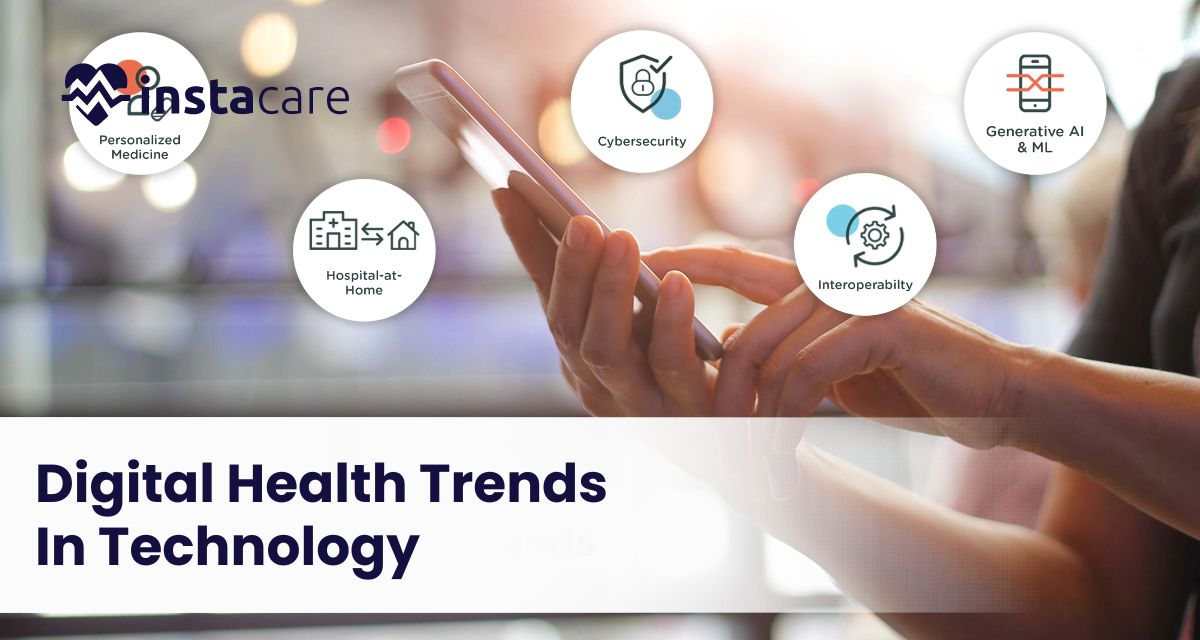
Here Are The Top 8 Digital Health Trends In Technology On account of innovation and forward leaps that significantly impact how we oversee and give medical care benefits, the medical care climate is evolving rapidly. Computerized well-being improvements, for example, telemedicine and man-made consciousness, are changing patient considerations, expanding proficiency throughout the medical services continuum, and further developing outcomes. We will take a gander at the main eight digital health trends In technology impacting medical care later on here. 1-Virtual Care And Telemedicine Patients may now talk with medical care specialists remotely because of telemedicine, which has turned into a crucial part of current medical services conveyance. Virtual consideration frameworks permit patients and specialists to impart progressively, disposing of the requirement for in-person visits for conclusion, treatment, and follow-up care. Accessibility And Convenience Patients might acquire medical care administrations from the solace of their homes by means of telemedicine, which takes out movement necessities and abbreviates stand by times. Better Access To Healthcare Individuals who live in remote or immature areas presently have better admittance to medical services on account of telemedicine, which permits them to talk with trained professionals and get care rapidly. Savings On Costs Telemedicine brings down medical services costs for patients and suppliers by wiping out the requirement for in-person arrangements and clinic stays. Improved Care Continuity Virtual consideration stages work with smooth correspondence between clinical experts, empowering collaboration and ensuring patients get steady treatment in different scenes. Care Quality Through safe video meetings, telemedicine maintains the norm of care by permitting clinical experts to do exhaustive assessments and oversee proof based treatments in a good way. Book Free Demo 2-Health Technology Wearables Digital Health Trends Wearable innovation, as smartwatches and wellness trackers, is empowering individuals to watch out for their wellbeing progressively. These contraptions screen imperative signs, movement levels, and rest designs, giving clients smart information on their overall wellbeing and prosperity. Monitoring Health In Real Time With the utilization of wearable wellbeing innovation, individuals may ceaselessly screen their pulse, oxygen immersion, pulse, and other imperative pointers to get constant criticism on their wellbeing. Monitoring Of Activities To propel clients to keep a functioning way of life and arrive at their wellness targets, wellness trackers and smartwatches track day to day action levels, including steps taken, distance voyaged, and calories consumed. Analysis Of Sleep To augment helpful rest, wearable gadgets measure rest examples, term, and quality. This assists clients with understanding their rest propensities and feature regions for advancement. Health Trends And Insights Wearable prosperity helps people with managing tenacious infections and changing their lifestyle proactively by giving them encounters into their overall prosperity plans through the examination of data collected for a really long time. 3-Augmented Reality (Ar) And Virtual Reality (Vr) Computer generated reality and increased truth are changing patient instruction, remedial therapies, and clinical preparation. Drenching careful reproductions and virtual recovery programs are just two instances of how these innovations give new ways to deal with work on understanding contribution and envision multifaceted clinical thoughts all these are part of new digital health trends. Training And Simulation In Medicine Clinical professionals and understudies might rehearse careful methods, physical analyses, and clinical situations in a protected and controlled setting with the assistance of VR and AR practical reproductions. Therapy And Education For Patients Through intelligent encounters, VR and AR applications show patients their clinical issues, accessible medicines, and recovery exercises, improving appreciation, adherence, and results. 4-Blockchain Technology In Medical Blockchain innovation is changing medical care through improved straightforwardness, interoperability, and information security. Blockchain further develops information honesty, speeds up regulatory systems, and grants safe trade of clinical records by laying out carefully designed, decentralized records. Safe Exchange Of Medical Records Blockchain makes it workable for patients, medical services experts, and different partners to safely share clinical records, bringing down the chance of information breaks and undesirable access while safeguarding patient security. Administrative Procedures Simplified Blockchain robotizes tasks, decreases desk work, and limits missteps to smooth out authoritative obligations including inventory network the executives, charging, and guarantees handling. This lessens expenses and increments functional proficiency. 5-Machine Learning And Artificial Intelligence By examining huge volumes of information to track down patterns, gauge results, and redo treatment regimens, man-made consciousness and AI advances are changing the medical services industry. Artificial intelligence is further developing clinical navigation and prodding advancement in tolerant consideration through applications, for example, prescient examination and analytic imaging. Analyzing Data And Identifying Patterns To track down examples, patterns, and relationships that take into consideration early sickness ID and individualized treatments, man-made consciousness calculations assess an assortment of medical care information sources, for example, hereditary information, electronic wellbeing records, and clinical imaging. Customized Care And Proactive Analytics Prescient investigation driven by computer based intelligence utilizes patient information to expect unfavorable occasions, treatment reactions, and the course of the infection. 6-Robotics In Telehealth Since they empower distant meetings and activities, telehealth mechanical technology is altering how care is conveyed. These innovations, which range from automated exoskeletons to careful robots, work on quiet results, give admittance to expert treatment, and widen the extent of medical services experts. Distant Consultations And Protocols In underserved or rural locations with limited access to experts, telehealth robots provide real-time interaction, examination, and diagnosis during remote consultations between patients and healthcare practitioners. Better Access And Better Results Healthcare practitioners may give prompt, personalized treatment to patients anywhere by utilizing telehealth robots. This reduces wait times, travel expenses, and healthcare inequalities, all of which eventually increase patient outcomes and satisfaction. 7-Remedial Arts Evidence-based treatments used to treat or manage medical diseases using software applications are referred to as “digital therapies.” These solutions, which range from diabetic management systems to applications for cognitive behavioral therapy, support conventional therapies and provide patients the tools they need to actively manage their health. Definition And Extent Digital therapies are a broad category of software-based interventions intended to improve general health and wellness or target particular medical disorders. These interventions use technology to provide evidence-based therapies,