

What Is World Pharmacists Day and Why It Matters to You Every pharmacist you’ve ever handed a prescription to shares one quiet anniversary. On September 25, 1912, a group of pharmacy leaders founded the International Pharmaceutical Federation in Istanbul. That date became World Pharmacists Day in 2009, and it’s grown into a global moment to recognize what pharmacists actually do for patient care. This guide walks you through where the day came from and what this year’s theme means. You’ll also see how pharmacists keep your medicine cabinet safer than you might realize. By the end, that person behind the counter should feel like more than a quick thank you. Why September 25 Became World Pharmacists Day The International Pharmaceutical Federation, known as FIP, picked this date for a simple reason. It’s the same day the organization itself was founded, back in 1912 in Istanbul. Turkish members of FIP suggested the connection when the federation created the holiday in 2009. That tied a modern celebration to over a century of pharmacy history. FIP isn’t a small group. It represents 144 national organizations and millions of pharmacists, pharmaceutical scientists, and educators worldwide, with its head office in the Netherlands. That reach is part of why the day carries weight in over a hundred countries. In 2020, FIP expanded the single day into World Pharmacy Week. The extra days give pharmacy associations room to run more events, campaigns, and outreach than one date alone could hold. This Year’s Theme, and How It’s Changed Over Time FIP sets a new theme every year, and for 2026 it’s “Empowering pharmacists for healthier futures.” The idea behind it is direct. Pharmacists need better training, clearer recognition, and stronger support from health systems if they’re going to keep patients safe and healthy. Part of that support increasingly comes down to tools. A pharmacist juggling paper records simply can’t move as fast or as safely as one backed by proper pharmaceutical software. Themes shift based on what healthcare is facing at the time. Here’s how the focus has moved over the past several years: Year Theme 2025 Think Health, Think Pharmacist 2024 Pharmacists: Meeting Global Health Needs 2023 Pharmacy Strengthening Health Systems 2022 Pharmacy United in Action for a Healthier World 2021 Pharmacy, Always Trusted for Your Health 2020 Transforming Global Health 2019 Safe and Effective Medicines for All Notice the pattern. Early themes focused on trust and safety. Recent ones push toward system-level change, asking governments and hospitals to actually invest in pharmacists rather than just applaud them once a year. What Pharmacists Actually Do Beyond Handing You a Bottle Most people picture a pharmacist counting pills behind a counter. That picture misses most of the job. Pharmacists catch dangerous drug interactions before they reach you, the kind that can turn two safe medicines into a serious problem when combined.They also run screenings you might not expect from a pharmacy visit. Blood pressure checks, blood sugar tests, and vaccinations often happen right at the counter now, no doctor’s appointment required. A quick chat with a pharmacist can flag a problem your GP might not catch for months. None of this runs smoothly without the right backend. Modern pharmacy software is what lets a pharmacist pull up your history in seconds instead of digging through paper files. Behind the scenes, pharmacists track bad drug reactions and report them, a process called pharmacovigilance. That reporting helps regulators pull unsafe medicines faster, protecting patients who haven’t even taken the drug yet. Pharmacists are also the most accessible healthcare professionals most people have. You don’t need an appointment. In the United States, more than 90 percent of people live within five miles of one. That kind of access matters most when someone needs quick answers, not a two-week wait. One more job rarely gets mentioned. It’s called antibiotic stewardship. Pharmacists help stop unnecessary antibiotic use, which slows the spread of drug-resistant infections. Skip this step, and treatable infections get harder to treat every year. Book Your Free Marketing Consultation How Pharmacists Keep You and Your Medicine Cabinet Safer Next time you’re at the pharmacy, ask more than “how many pills a day.” Ask about interactions with anything else you’re taking, including over-the-counter drugs and supplements. Also ask what side effects to actually worry about, not just what’s listed in fine print. Medication mistakes usually start out pretty small. Someone mixes two prescriptions without checking, or skips the dosage instructions because they seem obvious. A two-minute conversation with a pharmacist catches most of these before they become a real problem. If you want the fuller picture of how these errors happen and how pharmacies prevent them, our guide on medication safety and error prevention breaks it down in more depth. Old medications matter just as much. Pharmacists can tell you how to dispose of them safely. Flushing them or tossing them in the trash can let them end up somewhere they shouldn’t. How the Day Gets Marked Around the World Communities mark World Pharmacists Day in ways that fit their size and resources. Larger cities often run free health camps, offering blood pressure checks and medicine counseling to anyone who walks in. These camps move fast because the pharmacies running them usually lean on a proper pharmacy POS system to keep checkout quick even when the line is long. Universities and pharmacy associations host seminars on new practices and digital health tools. Smaller campaigns show up in schools and rural areas, spreading basic knowledge about safe medicine use to people who might not otherwise get it. Social media campaigns round things out, with hashtags and short videos aimed at younger audiences who scroll more than they read. Here’s a fun detail most guides skip. The inventors of Coca-Cola, Dr. Pepper, and Pepsi were all pharmacists. Somewhere between formulating cough syrups and studying chemistry, they ended up creating some of the world’s most popular drinks. Take the Extra Minute World Pharmacists Day marks more than a date on the calendar. It’s

Hospital Cash Flow Management for Beginners: A Simple Guide A hospital can post a profit in March and still struggle to cover payroll that same month. That gap confuses a lot of finance teams who assume revenue and cash mean the same thing. They don’t, and the difference is where most cash flow trouble starts. This guide breaks down why that gap exists, how the insurance claims timeline widens it, and what steps actually close it. You’ll walk away with a simple forecasting method you can start using this week. What Hospital Cash Flow Actually Means Revenue is money your hospital has earned on paper. Cash is money that’s actually sitting in your bank account, ready to spend. A hospital can bill $50,000 for a procedure today and not see that money land for six weeks or more. Hospital cash flow management is the practice of tracking when money comes in against when it has to go out. It sounds simple, but hospitals run into trouble because the timing rarely lines up. Payroll doesn’t wait for an insurance claim to clear. Neither do pharmaceutical suppliers or utility bills. This same idea scales up across the whole organization. Healthcare cash flow management applies it to every department, not just billing, because a slow month in one area can ripple into cash pressure everywhere else. Why Hospital Financial Management Can’t Rely on Profit Alone Here’s where the timing gap gets structural, not accidental. Insurance claims typically take 60 to 120 days to settle. Payroll, supplies, and operating costs fall due within 30 days. That mismatch, not poor management, is usually what drains a hospital’s cash. Picture a hospital that treats patients all through March. The bills for that care go out, and the revenue gets recorded. But most of that money won’t arrive until May or later. Meanwhile, March’s payroll and supplier invoices are due on schedule, no matter what the claims pipeline looks like. None of this means the hospital is being run poorly. It means the underlying billing structure creates a lag that has to be actively managed. Hospital financial management exists to handle exactly this problem, and the rest of this guide covers how. How Hospital Revenue Cycle Management Slows Your Cash Down Trace a single patient’s path from admission to payment and the delay becomes obvious. Care gets delivered over several days. The patient is discharged. Then the billing team has to assemble the claim and send it to the insurer. That submission step matters more than most people realize. A claim that goes out within 48 hours of discharge starts its clock immediately. One that sits on a desk for two weeks doesn’t. Hospitals running the right hospital management software can automate that claim generation straight from the clinical record, cutting the wait from days down to hours. From there, the insurer reviews it, sometimes raises questions, and eventually processes payment, often landing somewhere between day sixty and day ninety. Queries from the insurer are usually the biggest hidden delay. A missing code or an incomplete note can add weeks to a claim that would otherwise move fast. This is exactly why hospital revenue cycle management focuses so heavily on getting claims right the first time, not just fast. Shaving even a week off submission time per case adds up quickly across hundreds of claims a month. The Most Common Hospital Financial Operations Mistakes A few patterns show up again and again in hospitals struggling with cash, and most of them are fixable once you know to look for them. Overstocking pharmacy and supplies. Extra inventory sitting on a shelf is cash that could be covering payroll instead. Letting patient balances go untracked. Money owed after discharge ages fast, and without follow-up it often becomes unrecoverable. Submitting claims late. Every extra day between discharge and submission delays cash that’s already earned. Treating bad debt like a real asset. Balances that will never get collected shouldn’t sit on the books as if they will. Waiting for a shortfall instead of forecasting one. Reacting after cash runs short usually means emergency borrowing or paying premium prices for rushed supply orders. Each of these on its own seems minor. Together, they’re often the real story behind a hospital that looks profitable but feels broke. Book Your Free Marketing Consultation How to Build a Simple 13-Week Cash Flow Forecast This is the single most useful habit in hospital financial planning, and it’s less complicated than it sounds. Step 1. List every payment you expect over the next 90 days. That includes insurance settlements, patient installment payments, and anything else confirmed to arrive. Step 2. List every payment going out in that same window. Payroll dates, supplier invoices, loan payments, and utility bills all belong here. Step 3. Lay both lists out week by week. Any week where money going out exceeds money coming in, plus whatever cash you’re starting with, is a warning sign worth acting on early. Step 4. Update the forecast every week. A forecast that sits untouched for more than two weeks stops matching reality, and it loses its value as an early warning system. Once this becomes routine, cash flow stops being a monthly surprise. You start seeing shortfalls three or four weeks out, which gives you time to act instead of scramble. Hospital Budgeting for Your Cash Reserve Beyond week-to-week forecasting, every hospital needs a cushion built into its hospital budgeting plan. A reasonable target is 30 to 60 days of total operating expenses, held somewhere you can access quickly if needed. Say your hospital spends $500,000 a month to operate. That means aiming for $500,000 to $1,000,000 in reserve. It sounds like a lot, but it’s what covers a slow month of insurance payments, an equipment breakdown nobody planned for, or a seasonal dip in patient volume. Building that reserve doesn’t happen overnight. It usually comes out of a stretch where cash coming in stays ahead of cash going out, which is exactly why
World Patient Safety Day: A Beginner’s Guide to What It Means and Why It Matters One in twenty patients who receive medical care is affected by avoidable medication harm. That number comes from global health research, and it’s the reason a day like this exists. World Patient Safety Day isn’t a feel-good slogan on a hospital banner. It marks a real, ongoing problem, one that affects patients, families, and healthcare workers everywhere. This guide walks you through what the day is, what this year’s theme means, and what you can actually do the next time you’re a patient yourself. It’s also a topic our own team has engaged with directly, including at the 8th International Patient Safety Conference in Karachi. What Is World Patient Safety Day World Patient Safety Day falls on September 17 every year. The World Health Organization created it in 2019, after the 72nd World Health Assembly passed a resolution calling for global action on patient safety. The day is meant for everyone touched by healthcare: patients, family caregivers, nurses, doctors, hospital administrators, and the policymakers who write the rules hospitals follow. It’s one of a small number of official global health campaign days the WHO runs each year, which says something about how seriously the organization treats preventable harm. Why This Day Matters More Than a Slogan Medication errors alone account for close to half of all avoidable harm in healthcare. That’s not a niche problem tucked away in one department. It touches nearly every patient interaction, from a prescription written in a rush to a dose administered without double-checking the chart. Elderly patients and people in intensive care face the highest risk, which matters if you have older parents or a family member who’s ever needed critical care. Here’s the thing: most of this harm doesn’t trace back to one careless person. It usually comes from a system under strain. Short-staffed wards, rushed handoffs between shifts, and weak communication protocols create the conditions where small mistakes turn into serious harm. That’s what people mean when they talk about patient safety in healthcare systems. It’s less about individual blame and more about building processes that catch errors before they reach the patient. The World Patient Safety Day 2026 Theme This year’s theme is “Safe care for noncommunicable diseases,” with the slogan “Safe care for life.” Noncommunicable diseases include conditions like heart disease, diabetes, cancer, and chronic respiratory illness. These conditions rarely involve one visit and one treatment plan. A person managing diabetes might see an endocrinologist, a cardiologist, and a primary care doctor across a single year, each prescribing something different. Every added provider raises the odds that two medications conflict or a treatment plan falls out of sync. The 2026 theme exists because long-term, multi-provider care is exactly where safety gaps tend to open up. A Quick Look at How the Day Has Evolved The WHO changes its focus each year based on what’s failing patients most at that moment. Past themes tell the story: 2019: Patient Safety: A Global Health Priority 2020: Health Worker Safety: A Priority for Patient Safety 2021: Safe Maternal and Newborn Care 2022: Medication Safety 2023: Engaging Patients for Patient Safety 2024: Improving Diagnosis for Patient Safety 2025: Safe Care for Every Newborn and Every Child Each theme responds to a real, documented gap from that period. The 2020 theme arrived as COVID-19 put health workers directly in harm’s way. The shift to chronic disease in 2026 reflects how much of today’s healthcare now revolves around long-term conditions instead of single, short-term illnesses. What Improving Patient Safety in Healthcare Systems Actually Looks Like Hospitals don’t reduce harm through good intentions. They reduce it through specific, repeatable practices. Four stand out. Surgical safety checklists catch wrong-site or wrong-patient errors before a single incision is made. The surgical team confirms the patient’s identity, the procedure, and the correct site out loud, every time, no exceptions. A hospital management software system helps enforce this by making the checklist a required step before a procedure can even be logged. Barcode medication scanning stops wrong-dose or wrong-drug errors at the bedside. A nurse scans the patient’s wristband and the medication together, and the system flags a mismatch before the drug is given. Structured handoff protocols, often called SBAR (situation, background, assessment, recommendation), keep critical details from getting lost when one nurse’s shift ends and another begins. Without this, a small but important detail can vanish between shift changes. Accreditation standards like NABH or JCI force hospitals through regular, independent audits instead of letting them grade their own work. A hospital can’t just claim it’s safe. It has to prove it, on a schedule, to outside reviewers. How You Can Improve Your Own Patient Safety Systems matter, but you’re not powerless in the room either. A few habits make a real difference. Ask about every medication before you take it. Ask the name of the drug, what it treats, and what the normal dose looks like. If something sounds off, that question just caught a possible error. Confirm your identity out loud before every test or medication, even if the staff already seems to know you. State your name and date of birth yourself rather than just nodding along. Mix-ups in patient identification remain one of the most common preventable errors in hospitals, which is exactly why a reliable patient management software system matters behind the scenes. Bring a written list of every medication and supplement you take to each appointment. A new doctor has no way of knowing what you’re already on unless you tell them. This single habit, called medication reconciliation, prevents a huge share of dangerous drug interactions. Speak up without needing to be confrontational about it. A simple line works: “Can you walk me through why I’m getting this medication?” That question opens a conversation instead of starting an argument, and it gives the provider a natural chance to catch their own mistake. Bring someone with you when you can. A

InstaCare Partners with LCCI to Provide Premium Healthcare Benefits to 46,000+ Businesses Across Pakistan InstaCare, Pakistan’s leading healthcare platform, has officially partnered with the Lahore Chamber of Commerce & Industry (LCCI). This collaboration offers over 46,000 businesses across Pakistan access to exclusive healthcare benefits, including up to 30% discounts on lab tests, radiology, and consultations. Exclusive Healthcare Benefits for LCCI Businesses Through this strategic MoU, InstaCare provides affordable healthcare solutions to employees of LCCI-affiliated businesses. Key benefits include: 30% discount on essential lab tests, radiology services, and medical consultations. Access to InstaCare’s Super Health App for seamless health management. Workshops and digital health tools to promote wellness across the corporate sector. This partnership aims to make healthcare more accessible and cost-effective for businesses across Pakistan. Corporate Health Transformation: A Nationwide Initiative The collaboration is set to reshape corporate health programs in Pakistan. By leveraging digital innovations and workshops, InstaCare will support businesses in prioritizing employee health and wellness. These programs are part of a broader initiative to transform corporate healthcare in Pakistan, ensuring employees have access to high-quality services at discounted rates. InstaCare’s CEO (Bilal Amjad) said, “This partnership will significantly improve access to healthcare for thousands of employees across Pakistan. We are excited to offer these benefits to help businesses create healthier, more productive environments.” How InstaCare is Making Healthcare More Accessible As part of this initiative, InstaCare is bringing advanced healthcare technology directly to employees of LCCI-affiliated businesses. Through the InstaCare Super Health App, users can: Book appointments for consultations and tests. Access digital health tools to monitor and manage their health. Find nearby healthcare facilities offering discounted services. The app ensures quick access to healthcare services, making it easier than ever for businesses to maintain the well-being of their employees. About InstaCare: “InstaCare is a leader in corporate healthcare solutions, partnering with businesses across Pakistan to provide high-quality healthcare benefits for employees. With a mission to transform corporate wellness, InstaCare brings innovative health solutions to organizations, enabling them to provide affordable healthcare options for their workforce.” About Lahore Chamber of Commerce & Industry (LCCI): The Lahore Chamber of Commerce & Industry (LCCI) represents businesses across Pakistan, advocating for better policy and promoting business growth. The LCCI network serves as a platform for business collaboration and community development. Contact Information: Website: Instacare.com.pk Phone: (92) 309-4447192 Email: business@InstaCare.com.pk App Download: [Download InstaCare Super Health App]

InstaCare Hosts Sold-Out Workshop in Lahore: Transforming Healthcare Professionals into Business Leaders June 21, 2025 – Pearl Continental Hotel, Lahore InstaCare, Pakistan’s leading healthtech company, successfully hosted a high-impact workshop titled “Building a Patient-Centered Profitable Healthcare Business” in Lahore on June 21, 2025. The session was led by Bilal Amjad, Founder & CEO of InstaCare, and welcomed healthcare professionals from across the ecosystem — including clinic owners, lab managers, pharmacists, and hospital administrators. Location: Pearl Continental (PC) Hotel, Lahore Time: 3:00 PM – 5:00 PM Format: In-person + Virtual | Boardroom-style workshop Seats: Fully Booked (25 seats filled + online participation) Why This Workshop Was Needed In Pakistan, over 75% of small healthcare businesses plateau within the first five years, not because of a lack of medical excellence, but due to limited exposure to structured business education. This workshop was built to bridge that critical gap, offering hands-on training in: Pricing strategies & smart revenue models Financial leak detection Clinic-to-hospital growth roadmaps Leadership thinking for medical professionals Real-world profitability case studies Operational systemization More than just a lecture, it was a movement toward building sustainable, scalable, and patient-centered businesses in healthcare. The Impact 25+ Healthcare business owners turned decision-makers. Multiple specialties represented: clinics, labs, pharmacies, hospitals. Real questions. Practical answers. No fluff. Unforgettable energy and collaboration. “Most doctors are passionate. But no one taught them how to grow a business. This workshop changed that — from overwhelmed owners to empowered entrepreneurs.” — Bilal Amjad, CEO, InstaCare Who Attended? Clinic & lab owners Pharmacy entrepreneurs Hospital administrators Healthtech startup founders Medical professionals seeking growth What’s Next? This was just the beginning. Based on the overwhelming response, InstaCare is committed to bringing more high-impact workshops across Pakistan, combining clinical expertise with entrepreneurial skill-building. For updates or private workshop inquiries: business@instacare.com.pk Highlights Housefull event — Alhamdulillah Incredible engagement from medical leaders Actionable tools used during the session Patient-centered, provider-powered model of profitability Closing Note “Pakistan’s healthcare future doesn’t just need more hospitals — it needs smarter healthcare businesses. That’s our mission.” – Team InstaCare Let’s continue the mission to heal the business of healing.

InstaCare and LCCI Partner to Boost Digital Health Innovation in Pakistan In a landmark step toward strengthening Pakistan’s digital health ecosystem, InstaCare Pvt. Ltd. has announced a strategic collaboration with the Lahore Chamber of Commerce & Industry (LCCI) to drive healthcare innovation, affordability, and accessibility for the business community across the country. This forward-looking partnership was officially unveiled at the ICTN Expo, one of Pakistan’s leading technology exhibitions, where both organizations shared a joint vision of transforming healthcare access through digital solutions. Key Highlights of the Partnership Strategic Collaboration for Accessible Healthcare Through this collaboration, InstaCare and LCCI will work together to enhance digital healthcare access and affordability for companies operating under the chamber’s umbrella. This initiative aligns with both organizations’ commitment to empowering the private sector with better health resources for their teams and communities. Launch of the Digital Health Committee InstaCare and LCCI are also launching the first-ever Digital Health Committee within LCCI — a dedicated body that will champion entrepreneurship, policy advocacy, and ecosystem development for the healthtech sector. The committee will serve as a platform to connect startups, healthcare providers, and regulators to foster sustainable innovation. Exclusive Discount for LCCI Members As part of this collaboration, InstaCare will offer an exclusive discount of up to 30% on its digital health solutions to all registered LCCI member companies. This initiative aims to help organizations adopt reliable clinic management systems, telemedicine platforms, lab integrations, and more — at accessible pricing. A Shared Vision for Digital Health Empowerment Speaking about the partnership, Bilal Amjad, CEO of InstaCare, stated: “Pakistan’s healthcare transformation will only be possible when the private sector leads with innovation and accessibility. Our partnership with LCCI is not just a business collaboration — it’s a joint commitment to make healthcare smarter, fairer, and more future-ready.” A representative from LCCI added: “We are proud to partner with InstaCare to launch this important initiative. Digital health is the future, and this committee will play a vital role in promoting innovation and improving access for our members and beyond.”

InstaCare at DFDI Forum 2025: Shaping Pakistan’s Digital Health Future InstaCare is proud to have participated in the DFDI Forum 2025, a groundbreaking event organized by the Ministry of IT and Telecom Pakistan, where global investors, tech leaders, and policymakers gathered to discuss the future of digital health in Pakistan. This forum marked a historic step in shaping Pakistan’s digital transformation, securing an impressive $700 million in investment commitments on Day 1 alone. Pakistan’s Rising Digital Health Hub The event showcased how Pakistan is positioning itself as a regional hub for digital innovation, fostering foreign investments and nurturing technological advancements that will drive the future of digital health in Pakistan. It was a unique opportunity for us to engage in meaningful discussions, exchange ideas, and gain insights into how Pakistan is becoming an emerging leader in the digital health ecosystem. Digital FDI: A Catalyst for Growth in Pakistan The momentum at the forum was truly inspiring. With the Ministry of IT and Telecom Pakistan leading the charge, Pakistan is set to become a focal point for global digital partnerships and investment in tech innovations. InstaCare, as part of the digital health sector in Pakistan, is excited to contribute to this evolution by offering cutting-edge healthcare technology solutions, digital health platforms, and telemedicine services to millions of Pakistanis. Opportunities for Growth in Digital Health and Tech Investments The event highlighted the growing interest and commitment from global investors to contribute to Pakistan’s digital growth. With significant investments in telemedicine, healthcare IT solutions, and digital health infrastructure, InstaCare is poised to capitalize on these opportunities to expand its services and contribute to Pakistan’s digital healthcare landscape. By fostering tech investment and collaborating with global partners, we can drive innovation, enhance healthcare delivery, and create sustainable solutions for a digitally empowered future. Key Highlights of DFDI Forum 2025 $700 million investment secured on Day 1 Global discussions on the future of digital health in Pakistan and tech investments Strong emphasis on Pakistan’s role as a regional hub for digital innovation Collaborative opportunities for digital health solutions and telemedicine advancements Looking Ahead: Pakistan’s Digital Health Revolution The DFDI Forum 2025 has set the stage for a new era of tech-driven growth in Pakistan, and we are excited to be part of this journey. With investments flowing into digital health technologies and e-health solutions, Pakistan is on the brink of a digital health revolution, where healthcare services will be more accessible, efficient, and innovative. We look forward to continuing our efforts to enhance digital healthcare solutions, making a real difference in the lives of millions across Pakistan. Join InstaCare in Transforming Pakistan’s Digital Future At InstaCare, we believe that the future of healthcare lies in digital transformation. As part of the Ministry of IT and Telecom Pakistan’s initiative, we are committed to shaping the future of digital health in Pakistan. Stay connected with us and be part of the digital health revolution in Pakistan!
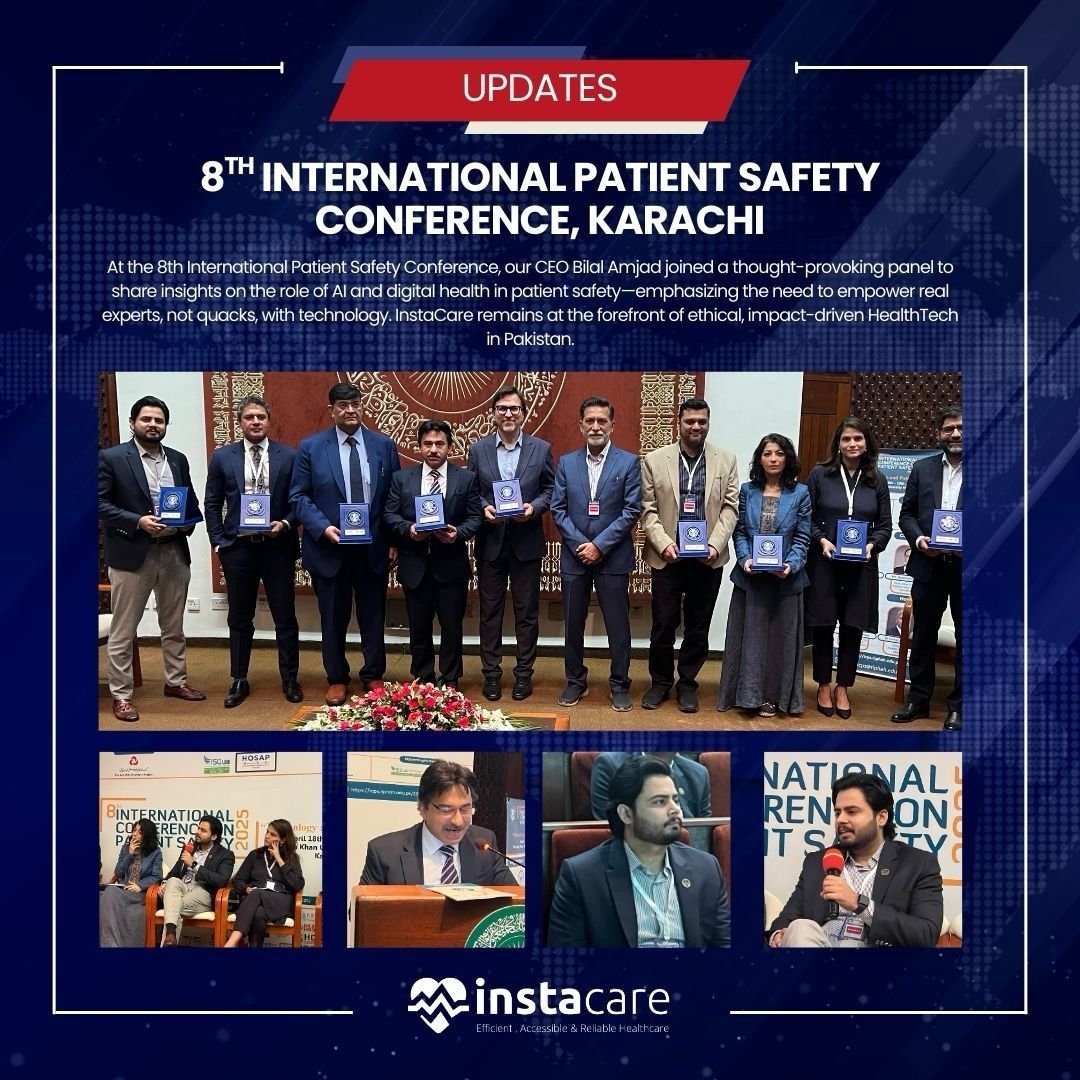
InstaCare at the 8th International Patient Safety Conference: Leading the Future of HealthTech in Pakistan InstaCare proudly participated in the 8th International Patient Safety Conference, held in Karachi and jointly organized by Aga Khan University and Riphah International University. This high-profile healthcare event brought together thought leaders, medical professionals, healthtech innovators, and academics from across Pakistan to discuss the most pressing challenges and emerging solutions in patient safety, digital transformation, and the future of Digital Healthcare in Pakistan. Our CEO, Bilal Amjad, was invited as a distinguished panelist to share insights on the critical role of Artificial Intelligence (AI) and digital health in improving patient safety and healthcare delivery. Representing InstaCare’s mission to build a safer, smarter, and more accessible healthcare ecosystem, Bilal highlighted the need to empower real healthcare experts—not quacks—through ethical technology and responsible innovation. Why Patient Safety Matters More Than Ever In a rapidly evolving healthcare environment, patient safety in Pakistan has emerged as a national priority. Misdiagnoses, medication errors, lack of access to licensed doctors, and delayed treatments continue to impact millions of lives every year. The conference addressed these systemic challenges and emphasized the urgent need for digital solutions in healthcare that are not only innovative but also ethical and reliable. As a healthtech leader in Pakistan, InstaCare recognizes that digital transformation must align with core healthcare values—safety, trust, and accessibility. It’s not just about deploying cutting-edge tools but ensuring that these tools are used by trained, qualified professionals to enhance patient outcomes. The Role of AI and Digital Health in Revolutionizing Patient Safety During the panel discussion, Bilal Amjad spoke on how AI, telemedicine, and cloud-based health platforms are redefining patient engagement, diagnostics, and data-driven treatment decisions. However, he stressed that the real potential of AI in healthcare can only be realized if deployed within a framework that prioritizes integrity, accountability, and transparency. “We must ensure that technology strengthens real healthcare systems—not replaces them with unverified or unsafe alternatives. Real change starts with enabling real experts, not quacks,” — Bilal Amjad, CEO, InstaCare. This message deeply resonated with the conference’s core theme and sparked a rich dialogue among fellow panelists and attendees about the future of digital health in Pakistan. InstaCare’s Commitment to Responsible and Impact-Driven HealthTech At InstaCare, we are driven by a simple yet powerful mission: to make healthcare in Pakistan more efficient, accessible, and safe for everyone. Our platform is designed to eliminate barriers between patients and verified medical professionals through: Online doctor appointments with PMDC-verified doctors AI-powered health records management for smarter care decisions Pharmacy integrations for safe and convenient medicine ordering Healthtech solutions for clinics and hospitals to optimize workflows and reduce errors By integrating ethical innovation with real-world healthcare needs, InstaCare is actively contributing to healthcare reform in Pakistan—building systems that are not only tech-enabled but also deeply patient-centric. A Powerful Platform for Reform and Collaboration We are immensely grateful to Aga Khan University, Riphah International University, and the organizing bodies for hosting a world-class platform that allowed voices from across the healthtech spectrum to connect, collaborate, and co-create the future of healthcare in Pakistan. It was inspiring to share space with fellow leaders, healthcare practitioners, and academics who are just as passionate about reimagining healthcare in Pakistan through responsible innovation. These dialogues are not only vital for reform but for shaping a digitally inclusive healthcare future. Looking Ahead: The Future of Patient-Centered Digital Healthcare The 8th International Patient Safety Conference served as a reminder that we’re at a critical juncture in the digital health journey of Pakistan. Technology is advancing rapidly, but its application must be guided by ethical standards and patient-first values. We remain committed to pushing the boundaries of what’s possible—through AI in healthcare, smart digital platforms, and by continuously listening to the needs of the communities we serve. With a clear focus on safety, transparency, and accessibility, we will continue to drive change that uplifts the quality of care for millions of Pakistanis. Stay Connected with InstaCare To learn more about our products and how we’re transforming digital healthcare in Pakistan, visit instacare.com.pk

Top Digital Health Company in Asia by CXO Global Forum InstaCare is proud to announce that the CXO Global Forum has honored it with the prestigious ‘Top Entrepreneur Award’. This recognition reinforces InstaCare’s position as the Top Digital Health Company in Asia and a pioneer in revolutionizing the healthcare landscape. Our innovative solutions and unwavering commitment to healthcare excellence have also earned it multiple accolades, including: Top Digital Health Company in Pakistan Best Healthtech Startup in Pakistan Best EMR and Practice Management Company in Asia These achievements reflect InstaCare’s dedication to leveraging technology to enhance healthcare accessibility, efficiency, and outcomes across the region. Bilal Amjad Reflects on InstaCare’s Commitment “This award is a testament to our mission of transforming healthcare through advanced digital solutions,” said Bilal Amjad, CEO of InstaCare. “We are committed to empowering healthcare providers and patients with tools that elevate care delivery and contribute to a healthier future for everyone.” As a leading digital health platform, we continue to innovate and deliver impactful solutions, including: Electronic Medical Records (EMR) Practice Management Systems Telemedicine Patient Engagement Tools Our efforts are bridging the gap between patients and healthcare providers, ensuring that healthcare is more accessible, efficient, and affordable across Pakistan and beyond. The recognition by CXO Global Forum underscores InstaCare’s vision of setting new benchmarks for healthcare technology, bringing innovation, and making a lasting impact on the healthcare industry.

InstaCare Participates in 3rd International Family Planning Summit at Jinnah Sindh Medical University InstaCare, a leader in digital health, participated in the 3rd International Family Planning Summit at Jinnah Sindh Medical University (JSMU), Karachi. The event brought together experts to discuss strategies for improving family planning services and healthcare access in Pakistan. Youth and Male Engagement in Family Planning Through Digital Solutions Bilal Amjad, CEO of InstaCare, joined a panel discussing “Youth and Male Engagement in Family Planning.” The session explored how digital health platforms can increase family planning uptake, especially among youth and men. The discussion was part of Population Services International (PSI), Pakistan’s initiative to integrate technology with healthcare access. InstaCare and PSI Partner to Improve Family Planning Accessibility Across Pakistan InstaCare’s collaboration with PSI aims to expand family planning services nationwide by integrating digital health solutions with community outreach programs. The partnership focuses on making family planning services more accessible, affordable, and impactful. “We are excited to partner with PSI. Thank you, JSMU, for hosting this event,” said Bilal Amjad. “Together, we’re improving healthcare access and ensuring modern solutions reach everyone in Pakistan.” InstaCare Thanks Karachi for Hosting the 3rd International Family Planning Summit InstaCare extends its gratitude to Karachi for its warm hospitality and support in making the summit a success.